|
|
|
TCHS 4O 2000 [4o's nonsense] alvinny [2] - csq - edchong jenming - joseph - law meepok - mingqi - pea pengkian [2] - qwergopot - woof xinghao - zhengyu HCJC 01S60 [understated sixzero] andy - edwin - jack jiaqi - peter - rex serena SAF 21SA khenghui - jiaming - jinrui [2] ritchie - vicknesh - zhenhao Others Lwei [2] - shaowei - website links - Alien Loves Predator BloggerSG Cute Overload! Cyanide and Happiness Daily Bunny Hamleto Hattrick Magic: The Gathering The Onion The Order of the Stick Perry Bible Fellowship PvP Online Soccernet Sluggy Freelance The Students' Sketchpad Talk Rock Talking Cock.com Tom the Dancing Bug Wikipedia Wulffmorgenthaler       |
|
bert's blog v1.21 Powered by glolg Programmed with Perl 5.6.1 on Apache/1.3.27 (Red Hat Linux) best viewed at 1024 x 768 resolution on Internet Explorer 6.0+ or Mozilla Firefox 1.5+ today's page views: 684 (37 mobile) all-time page views: 3906410 most viewed entry: 18739 views most commented entry: 14 comments number of entries: 1295 page created Thu Oct 22, 2026 21:35:07 |
|
- tagcloud - academics [70] art [8] changelog [49] current events [36] cute stuff [12] gaming [11] music [8] outings [16] philosophy [10] poetry [4] programming [15] rants [5] reviews [8] sport [37] travel [19] work [3] miscellaneous [75] |
|
- category tags - academics art changelog current events cute stuff gaming miscellaneous music outings philosophy poetry programming rants reviews sport travel work tags in total: 386 |

| ||
|
...After the international layoff, in which England were positively negative. The dropping/unavailability due to Rooney-inflicted injury of Lampard, allowing McClaren to stop him and Gerrard from getting in each others' way, only yielded a 3-0 win against the part-timers of Andorra (pop. 71201). Can't say I've done much better in my predictions, with West Ham and Man City conspiring against all form to sink me the last time I tried my hand at virtual punting. Currently: $2007.25/$2600. Well, I'll stick at it out of professionalism, even if like Arsenal (being wiped out 3-0 at Liverpool at the moment) I have little to play for. Blackburn can be dicey and United are very short at 1.28 for the win, so I'll stay clear of that. Chelski are at a very tempting 1.90 to win by two or more at bottom club Watford, but knowing my luck they'll probably score one and then clam up. $10 on West Ham to beat Middlesbrough (at 2.10) - Coming good? $20 on Bolton to beat Sheffield United (1.55) - Back on the trot $30 on Chelski (-1.5) vs Watford (1.90) - Okay, couldn't see anything better $40 on Charlton to draw Wigan (3.10) - Just me trying to make up lost ground
- academics - I thought I was feeling slightly depressed this part fortnight, but it turned out to be a case of the body leading the spirit. Panadol did nothing for my persistent flu, but a course of antibiotics and some Fenfedrin/Diclofenac from the neighbourhood GP got me back into good working condition in no time. It's so much better to tackle problems without having to feel sick. As Sven might say... 
And I'm getting used to air-conditioning on those hot nights. Hey, work productivity drops by about 2% for every degree the temperature is above 25 degrees Celsius. It's for my own good. Oh, and for any philo novices like me who wish to read Nietzsche, more specifically his Thus Spoke Zarathustra , I found T.K. Seung's Nietzsche's Epic of the Soul: Thus Spoke Zarathustra extremely helpful. On a sidenote, the seats by the sides of the wall in the library were so comfy that even at 10 a.m., I daresay that half of their occupants were asleep reclined in them. Then there was this librarian and her supervisor who participated in a rather comic skit - the ostensibly new librarian had a habit of hitting the books audibly against the trolley while she was rearranging them, to which her exasperated supervisor told her none to politely not to "bang the books". The funny thing was that this was repeated half a dozen times at least, whereby the supervisor finally asked the question I was expecting - "You understand English or not?" Don't know how to deal with these situations where the other party is not defiant, but just cheerfully agrees "Yes Yes Yes" and continues doing his own sweet thing. Perhaps this is more common in Asian societies where it is considered impolite to disagree outright? 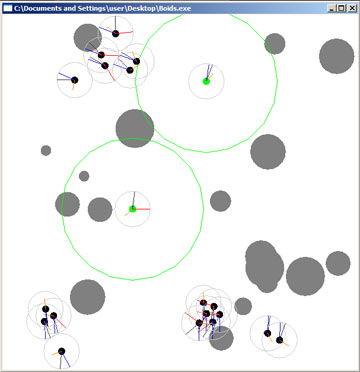
Boid = Bird-oid Finally, Wednesday's presentation on flocking Boids was one of the few I ever really had fun with, since the topic was itself interesting, and not least since I had a program to demonstrate the concept too. When the lecturer asked me how long I took to code it, I internally debated on whether to be more humble or honest, and went for the latter - it did take me just Tuesday afternoon. Download the executable and presentation (2.01 MB).
- academics - current events - About three weeks remaining for three computing projects, which I'm getting a bit hung up on. The big question would be: How much work is expected for an A? Oh, and to those who say "just do your best" or "it's not about the grades, it's about the learning process", I thankyouverymuch in advance, ah. I first got hung up on this when I attempted to build a working mini-desalination plant for my Social Studies project in primary school, with the individual structures made out of aluminum-foil wrapped mounting board fronted with the transparent plastic sheeting used to protect schoolbooks. The pipes between the structures were similarly manufactured, and the stages of desalination lifted from the textbook, with the whole thing mounted on a styrofoam board. There was one little problem - it leaked early on, and obviously didn't work. And it scored less than a map of Singapore made out of different coloured beans. That was not the last word on harebrained ideas, of course. My idea of producing heat with a bunch of shortcircuited AA batteries to melt ice cubes was soundly beaten by another team that simply crushed the ice cubes and mashed them in their hands, but that I have no complaints about. More than ten years on, it is more of the same in university. I get an idea that appears new, useful and good, but after I state it, it looks more and more to be rather trivial, the sort that anyone beginning from the same starting point would have come up with. For example, given a problem that requires some form of search, there are only so many search algorithms that are known, and it is hardly an exercise in imagination to try all of them. Then, given a composite problem, there remains only the question of finding all the ways into which it can be broken up into subproblems, and then for each of these subproblems, try all the methods that may work. Mere enumeration and testing obviously will take time, and the difference between great researchers and those of the ordinary ken would probably be (A) knowing more methods and algorithms, (B) being able to apply them quickly, and (C) being able to infer relationships between subproblems, and mentally eliminate those methods that will not work, without trying them (fellow CS students may recognize this as pruning). Even this much is not obvious, though, as evidenced by the esteemed Hungarian mathematician George Pólya, extremely influential 1945 classic on problem solving, How to Solve It. Its brief outline is as follows: 1. First, you have to understand the problem. 2. After understanding, then make a plan. 3. Carry out the plan. 4. Look back on your work. How could it be better? Very reasonable, but even the clever among us sometimes fall prey to not following this framework. Recently, I heard a fellow student asking a TA why his program wouldn't work on his system. The TA asked him whether he modified his program from the example program given. The student replied that he had. Then the TA asked him whether that example program worked on his system. The student replied that it didn't. Duh. But everyone has their off-days. Well, Edison said that "Genius is one percent inspiration and 99 percent perspiration", and I hope he's right. Time to just sweat it out and hope for the best. At least two of those projects are individual work, which simplifies matters. Fred Brooks' famous "Bible of Software Engineering" (so named because everyone reads it but nobody actually practices what is being preached in it) The Mythical Man-Month states that "adding people to a late software project makes it later", also known as Brooks' Law. I had previously accused Brooks of just stating the obvious; In another of his famous papers, he proposes approaching essentially difficult software engineering problems by training great designers - imagine a scientist concluding his paper on a physical problem by suggesting that we increase educational funding for future scientists! However, on reflection, that was one of the few honest answers that could be given to such a wide problem, and in any case this world needs more common sense, not less. The title of The Mythical Man-Month arises from the observation that software engineering (and indeed many other jobs) cannot be hastened by throwing more men on the job. To illustrate, say we want a one kilometre long ditch. One man might be able to get the job done in ten days, five men in two days, and ten men in a day. The man-month is a valid unit of work in this case. However, if we want a one kilometre deep ditch, the extra men will not be able to work at a deeper depth simultaneously - the time taken then will not be reduced by any significant amount even with an army to do the job. Each project probably has an optimal number of people that should work on it. Say if there is a large number of simple individual projects, it may be best for the group members to divide them and work on a number of them individually, rather than attempt to collaborate on each one. Having too many people to begin with will often degenerate into politicking - the more conscientious will worry about not doing their fair share, and the lazy will worry about not appearing to do their fair share. There is probably nothing so sad (and fatal) as a conscientious but incompetent group member, though. One knows that he is trying his best, but is simply not up to it, whatever he does will likely have to be greatly edited or fully redone, which may be taken very badly by him. From a larger perspective, it might be most efficient to tell him to just sit on the sidelines and twiddle his thumbs - I am reminded of the Dilbert cartoon where a rather hopeless employee boasted that he worked overtime on the job, and the rest responded that they all had to work overtime the next day to fix the mistakes he introduced. Yes, there is always the soft option of just letting him "do his part" and submit the project with huge flaws, resulting in Bs or worse for everyone. Truly a tough decision. At least the irresponsible and incompetent group member will relinquish his task with few protests. The corollary from this is not to be too insulted when not assigned a significant part of a project. It is highly possible that the project was really too small to be evenly distributed anyway, and the single significant part, if there is one, is best tackled individually. Moving on to local news: Our worthy ministers' salaries (currently about US$800k a year) are set to rise, "to close a 55 percent gap with private sector income levels". Let's begin by considering how ministerial pay is determined. It is supposed to be pegged to "two-thirds of the median income of the top eight earners of six professions". Not too sure about exactly what this means - do we take the median of the 48 rich guys, or take the median of the six professions and average them? In any case, it's a lot of money. A few observations: One, is private sector pay consistent? It is not improbable that pay fluctuates greatly on an annual basis - a lawyer may win a lot of big cases one year, but not be as fortunate the next. On average a small number of them will have great years, of course, and guess who contributes to the peg? Two, the median pay of the top eight or 48 is hardly reflective of the well-being of society at large. If this median pay suddenly shoots up, does it mean that the ministers have done well? Probably fairer is a peg to say 100 times the salary of the median Singaporean, although on second thought that may not sound very palatable. Oh, and heaven forbid our search for talent attracts Bill Gates to Singapore. Three, the private sector is likely far more unforgiving than the civil service. Fail to meet expectations in a competitive environment, and one's out of a job. It is an open question if top civil servants would actually be able to secure a comparable salary, for years on end, in the outside world. One response to this is that ministers do have a competitive check - they have to face elections every five years. Please excuse me while I roll on the floor. Four, the main justification of high salaries has always been that if salaries are low, top civil servants would either jump to a higher-paying job, or turn corrupt. I don't know, but if I walked up to them and asked if they would be tempted to practice corruption if they were paid the meager income of say S$20k a month (about a fifth of their current income), I would be entitled to expect no for an answer. But, part of Singapore's operating philosophy has always been pragmatism, after all. Here, service to the nation coincides with service to the self, and it is impolite to enquire about the two separately. Five, the salaries are tellingly out of proportion to the rest of the world. For leading the world's greatest superpower, the President of the United States receives US$400k a year, less than half what our Prime Minister gets, and also less than what a normal Minister gets. Look around the rest of the developed world, which we have attempted to emulate in many respects - nowhere else do we see such figures. Surely they face the same issues of brain drain and possible shenanigans? Perhaps they do indeed supplement their income through other means, in which case we can rightly be proud of pre-emptively supplementing income through official means. Singapore rules!
- programming - Subject: A code fragment of the A* search (pathfinding) algorithm, coded from scratch. pa[C+maxcol*R][0] stores the row of the parent node of the node at row R and column C. pa[C+maxcol*R][1] stores the col of the parent node of the node at row R and column C. This algorithm desires to begin from the goal node and work backwards, thus printing out the path to the start node. There is one small mistake that cost me about an hour. Where is it? (Alvin Award up for grabs!) while (!(tr==-1 || tc==-1)) { length++; printf("NODE: %d %d\n", tr, tc); if (!(tr == startrow && tc == startcol) && !(tr == endrow && tc == endcol)) { ma[tr][tc] = 8; } trl = tr; tcl = tc; tr = pa[tc+maxcol*tr][0]; tc = pa[tc+maxcol*tr][1]; }
Been slightly listless these couple of days - a runny nose may have something to do with it - but watching Man Utd go on the rampage once more against Bolton went a long way towards curing that. It would have been four-nil like their first meeting, but for a phantom push by Vidic. Very soft penalty to give. Part of illness is in the head, probably. "Certainly, strength of spirit is a substance that should fill the jar of the heart to the brim" - Taiko, Eiji Yoshikawa Chelski will probably manage to beat Sheffield United to keep the gap at six, but the odds on that are far too thin for my liking. Instead, I'll be getting cozy with West Ham, who haven't been able to buy a win in recent weeks, most notably crashing 3-4 to Spurs after being 2-0 up at half time. $117.60 last time round, for $2007.25/$2500. $50 on Blackburn to beat West Ham (at 1.50) - Hammers lost last five in a row. $50 on Middlesbrough to beat Man City (at 1.75) - Boro terrific at the Riverside.
- + epl tales - 
<A> huh cannot nowadays need both iq n eq <B> huh no need lah csq enough <A> hor
This afternoon, after alighting from my usual bus-stop opposite NUS and crossing the overhead bridge, I saw lecture notes that would probably have filled dozens of files strewn all along the grass slope and attendant longkang. A cursory glance indicated that their former owner had not been particularly academically inclined. Then there was a heavy downpour in the afternoon, and when I returned at night only the lone and level waters stretched far away. There must be some profound significance to all this, but I haven't found it. Clearing up some backlogged commentary... Are the big doomed to be evil? GoogleTube video . If the Mac ever becomes dominant, will it suffer the same fate? Clearly though, this is pure speculation. The legitimate King of France is an Indian. Our defence budget is about one-tenth of China, to protect 0.0073% the land. I don't know about you, but I feel incredibly secure. We have the seventh largest foreign reserves in the world at US$139 billion, close to India and above Germany - in fact more than any European country. The United States has US$65 billion. But as former US Secretary of the Treasury John Connolly said, the greenback is "our currency, your problem".
- academics - music - Here's the last few days, in reverse chronological order: Monday: Got back the Physics and Microeconomics midterms, and a Physics lab report. On the Physics midterm, lets just say that I got back from the away leg 0-1 down. But then again it's only 10%, the labs and tutorials are probably worth twice that, and if I can't score in the home leg it won't make any difference anyway. And my Physics-major cousin wants to whack me in that module. Pressure pressure! At least the lab reports so far have been decent. Suffered a literal headache in carrying out the last experiment on atomic spectra, brought on by staring at damnably bright lines composed of all sorts of wavelengths through a microscope for an hour. Felt like vomiting at the end of that session. The one this Monday was much better, only requiring me to measure the diameter of electron diffraction rings. If only my voltmeter's needle worked properly, it would have been completed much more quickly. The needle got stuck at the 3kV mark, I brought in my lab TA to have a look, he confirmed the problem, we brought the lab staff over, and then lo and behold, Mr. Needle was innocently resting beyond 4kV. And after the two of them left, the needle reverted to holding firm at 3kV no matter how I twisted the knob. Ended up delivering a series of sharp (measured) blows to the top of the voltmeter to knock some sense into it. Who says violence doesn't solve any problems? This leads me to recall a particular very nice lab staff who talked to me about the stand for equipment that he designed, in my first lab session. I can always appreciate some pride on one's work. Now the Microecons midterm (40% of total module grade). Remember my take on it eleven days ago? "At best decidedly average, I suppose..." Well, I was wrong. Turns out that the lecturer did give partial credit for the procedure, and I ended up overshooting the class average of 52 by 30 marks. Most satisfyingly, I somehow managed to get a full 40/40 marks for the "most difficult" Question three, nearly matching the given solution word for word. Blur tio. Got a little exclamation point to mark the occasion some more. Can't resist blowing my own trumpet here. *Toot toot toot*. Then again, I guess it's nothing too special after all - remember (and understand) some formulae, apply them, don't make stupid mistakes en route. So this time, I managed to do that well. Big deal. I would probably fail it if told to sit for it again this very moment. Hey, I'm a big idea kind of guy, I don't like to keep the nitty-gritty details in my head. Other than the Planck's blackbody radiation formula that's somehow stuck in my head. Here we go: I-lambda,T is equal to 2 pi h c squared over lambda to the power of five open bracket e to the power of h c over lambda k-e T minus one close bracket. With some luck I'll manage to forget it by the time I graduate. Game theory, one of my pet topics, is coming up for Microecons next, so with some luck I won't have trouble passing the module. It won't count towards my CAP, remember? Hmm, so if I manage to grab an A for it, would it be counted as 损人不利己? Wah, suddenly I feel so evil. Sunday: Gana persuaded by Law to attend his SMU band's Symphonia Festiva: Con l' espressione at the Singapore Conference Hall, and fork out S$15 for the privilege of doing do. To make up for that, I influenced edchong to go, but he fell sick. So in the end it was just alvin, sel, smk and me. 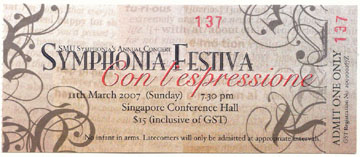
Infants may only be kicked into the hall. Was never that big on music, and never had too much of a ear for it either, but pieces in the classical tradition are pretty timeless. Enjoyed the casually staged Technology by Jim Casella, and after that the next favourite would probably be Samuel R. Hazo's Danse Diabolique. Supposedly the performance had some mistakes here and there, but I can't pretend to be able to tell whether some dissonance is unintentional or part of the performance. Just as diners praised branded mineral water to the high heavens even when a news team had secretly replaced the water with normal tap water beforehand, in an experiment some time back. Well, we refrained from shouting for a refund after the show, and to show our support for law we hoisted a large banner over the stage during the interval. The management made us take it down. 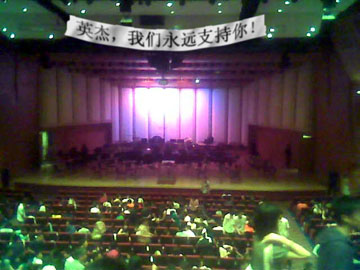
The banner speaks for itself. Alvin got accused of being chee hong when he kept asking about one of the band girls with shoulder-long hair. Turns out that she's from NUS. I sense wanted posters being plastered about campus soon :P Oh, and I finished coding a simple version of Puzzle Bobble (with sound!) for my last 3D Game Programming lab assignment before rushing down for the event. There's at least one bug I know of, but the very appropriate Unreal Tournament announcer makes up for it. Download the executable (1.04 MB). Caution: may need openAL (more on this below). Saturday: Was coding the above lab. Lesson learnt: Getting sound functionality in C++ isn't as straightforward as one may expect, especially when the whole bleeping openAL library website was down. And no other site seemed to have a mirror (maybe some had, but I couldn't find it, I'm not the Google shen), they all linked to that site. What good is the redudancy of the Internet here? In the end I downloaded a copy of the openAL SDK from the Creative Developer site. Only to find out that it didn't have some required freealut headers and libraries. A lot more Googling later, I found the files on a German open source flight simulator website. Didn't care about version compatibilities at that point, just chucked it in. It worked. Three cheers for German flight simulator programmers! Friday: Went to NUS for a SIGAIGAMES meeting, where everyone cheerfully revealed that they had been thinking really hard about it and would get down to the actual coding real soon. Fighting other fires first, I said. Had lunch at the makeshift Arts canteen and collected tickets from law there before that. Some of the seats at the makeshift canteen were better than those we're used to! Thursday: Well, I was salvaging some fun trading faces with a stray cat at the lift landing after that soul-crushing Physics midterm, when the lift doors opened and the young lady inside freaked out at the cat standing right at the lift entrance. It wasn't even a big, aggressive cat or anything, just the normal kind one can find in any self-respecting HDB estate. So there were several seconds of a standoff as she shrank to one corner of the lift, with the cat looking at her not comprehending what was going on. Or maybe it did, and was just getting a kick out of spooking a creature many times its size. Wanting to get home, I did what I believed was the gentlemanly thing and placed myself between the cat and the girl. It appeared to work, as she mustered up the courage to nip out, while muttering what I took to be a sincere thanks. Question: Has anyone ever been afraid of a bunny? Unfortunately it works the other way too - a couple of semesters back, while rushing to a test, I cut in front of a girl and ended up being berated for not being a gentleman. Then, I was all wtf, first time and kena. Maybe she had a bad day or something. *shrugs*
- academics - poetry - So the sunset of the midden is over, its circles of light in hand; A casualty of surds was I moreover, as a freedman, I must repent. Some small powers led to thy downfall, mere quantities of size and speed, Between Gordian constants, and variables, and twisted formulations replete. Dark is the perfection that stains thy mind, dark is the heart that beats, Timorously as it peeks fearfully at the standard fought for and unreached; As sorrow was wont to yield despair, I heard the voice of my reason say, Shame on thee who would bide the years, broken thus by fault of a day. Whyfore weep thee, whyfore mourn? For what, that poor character of a grade? Whyfore compose liturgies for that which yet lives, dying but undead? Thy strength was never hidden in numbers, those deathless digits that lie, But joy and delight in lifelong sentences, for although these may die; They were thy song and laughter, thy adored and unmarred chatter; Lovingly, they held thy long, unlike that matter which would not matter. Weary thy are of thy counting, scaling long steps to some answer, To a question thy never asked but forced to, like a poor and unthirsty dowser; Scrabbling amongst wellworn rocks, granite hewed from giants that were, Prospecting mere dust from mighty shoulders - how hard it is, to hold that dear. (with apologies to Algernon Swinburne)
- academics - Alas, I am not the sort of Speaking of constants, one of my (smarter) friends was complaining that he predicts a couple of B grades for his modules this semester. Not trying to be unempathic, but I kinda have a hard time believing his self-predictions from past experience. This leads me to postulate a Grade Optimism Constant A+* for each student, such that G = A+*G', where G' is the average predicted grade (numerical value) and G is the average actual grade. Clearly if A+* > 1, the student is a pessimist, and if A+* < 1, he's an optimist. I think that particular friend has an A+* of like 1.5. Oh well, here's what we're supposed to know after half a semester of modern physics. Enjoy. Time Dilation Δt = γΔtp where Δtp is the proper time (at rest with respect to the clock) Δt is the time measured by an observer moving with respect to the clock γ = 1/√(1 - v2/c2) N.B. γ ≥ 1 i.e. a moving clock is always observed to run slower than one at rest (by a factor γ) Length Contraction L = Lp/γ where Lp is the proper length (at rest with respect to the observer) L is the length measured by an observer when it moves at speed v in a parallel to its length N.B. 1/γ ≤ 1 i.e. a moving object is always observed to be shorter than one at rest (by a factor 1/γ) Galilean Transformation equations (S to S' frame) x' = x - vt y' = y z' = z t' = t Lorentz Transformation equations (also S to S' frame, discovered in 1890 - relativistic) x' = γ(x - vt) y' = y z' = z t' = γ[t - (v/c2)x] Lorentz Velocity Transformation (be very careful of the sign of v used!) u'x = (ux - v)/[1 - (uxv)/c2] where v is the relative velocity of another inertial frame S' relative to the observer's S frame ux is the velocity of the object relative to the S frame u'x is the velocity of the object relative to the S' frame N.B. As with above, to find ux instead of u'x, let all v be -v and interchange the primed variables. Conservation of (relativistic) momentum, p p = γmv where m is the particle mass and v is the particle velocity N.B. relativistic momentum ≥ classical momentum, most prominently at velocities approaching c. Conservation of (total) (relativistic) energy, E E = γmc2 = KE + mc2 where KE is the kinetic energy of the particle mc2 is the rest energy (independent of velocity) Energy/Momentum of zero mass particle E = pc i.e. p = E/c where p is the momentum of the particle N.B. A massless particle can still have momentum! Equivalence of mass and energy E = mc2 Wien's displacement law λmaxT = 0.2898 x 10⁻² m.K where λmax is the peak wavelength T is the temperature of the blackbody in Kelvins (K) 0.2898 x 10⁻² m.K (sometimes denoted by b) is Wien's displacement constant Rayleigh-Jeans Law (classical description of blackbody radiation) I(λ,T) = 2πckBT/λ4 where kB is Boltzmann's constant Planck's blackbody radiation formula I(λ,T) = 2πhc2/λ5(ehc/λkBT-1) where h is Planck's constant Einstein's photoelectric effect equation Kmax = hf - φ where φ is the work function (on the order of a few eV), varies from metal to metal Cutoff frequency, Fc = φ/h (if f < Fc, no emission is possible) Cutoff wavelength, λc = c/f = hc/φ (if λ > λc, no emission is possible) Compton scattering equation Δλ = λ' - λ0 = (h/mec)(1-cosθ) where me is the mass of an electron θ is the scattering angle h/mec is also known as the Compton wavelength of the electron General formula for spectral lines in Hydrogen 1/λ = RH[(1/n2f) - (1/n2i)] where RH is the Rydberg constant θ is the scattering angle nf and ni are integers, and nf > ni N.B. The Balmer series is when nf = 2, and ni = 3,4,5... It is the first visible series. Lyman series - nf = 1 (ultraviolet light, cannot be seen) Paschen series - nf = 3 Brackett series - nf = 4 Energy of the hydrogen atom E = -kee2/2r where ke is the Coulomb constant e is the elementary charge of a single proton r is the radius of the electron orbit Radii of Bohr orbits in hydrogen rn = n2h2/(2π)2mkee2 where n = 1,2,3... N.B. The orbit with the smallest radius (Bohr radius, a0) corresponds to n = 1 General expression for the radius of any orbit rn = n2a0/Z where n = 1,2,3... and Z is the atomic number (number of protons in the nucleus) of the element (1 for hydrogen) General expression for the energy quantisation of electron orbits En = -[Z2/n2]kee2/2a0 where n = 1,2,3... and Z is the atomic number (number of protons in the nucleus) of the element (1 for hydrogen) N.B. En = -13.6/n2 eV for hydrogen (by inserting the numerical value of kee2/2a0) de Broglie wavelength of a particle λ = h/p = h/mv N.B. not to be confused with the Compton wavelength Maximum intensity (white fringe) of Young's double slit experiment D sin θ = nλ where D is the distance betwen the slits n = 1,2,3... Minimum intensity (dark fringe) of Young's double slit experiment D sin θ = nλ where D is the distance betwen the slits n = 1/2,3/2,5/2... Heisenberg Uncertainty Principle ΔxΔp ≥ where N.B. some sources appear to quote this equation as ΔxΔp ≥ also, ΔEΔt ≥ this sets a limit with which the energy E of a system can be measured if a time interval Δt is allowed for the measurement. Allowed wave functions for particle in a box ψ(x) = A sin(nπx/L) where L is the length of the box x is the position of the particle N.B. the particle can exist in an infinite number of states n. Allowed momentums for particle in a box p = h/λ = nh/2L Allowed energies for particle in a box En = (h2/8mL2)n2 = n2E1 where n = 1,2,3... N.B. the least energy the particle can have in the box is when n = 1, also called the zero point energy. The particle cannot have zero energy. Constants Used Bohr radius = 5.29 x 10⁻¹¹ m Boltzmann's constant = 1.38 x 10⁻²³ m2 kg s-2 K-1 Coulomb's constant = 8.988 x 10⁹ N m2 C-2 Electron-volt (eV) = 1.60 x 10⁻¹⁹ J Electron mass = 9.11 x 10⁻³¹ kg Elementary charge = 1.602 x 10⁻¹⁹ C Planck's constant = 6.626 x 10⁻³⁴ m2 kg s-1 Rydberg constant = 1.097 x 10⁷ m-1
- music - My barber's back, so I got myself a haircut. Feel much better now without those strands brushing against my forehead. I'm no Samson, but I won't be going Britney either. Modern Physics midterms on Thursday, so I guess I'll get that done and over with before worrying about my three graded projects (two months remaining). Wasn't in the mood to do anything serious last weekend, so I just caught up with embellishing and sorting my notes. Also, the computer connected to the printer is cranking up again, freezing at the user select screen without explanation at times. Grr. I think I'm getting a bit stressed over those projects for no good reason. Envy those Danes - their secret to happiness? Low expectations. Simple and tempting, but I guess I've been bred to be too competitive. C'mon, loosen up! The junior rat race has its upsides, though. Here's the Campus Streetwise Tip of the Day: Q: What should you do if you are confronted by armed robbers who demand your money or your life? A: Show them your matriculation card. They will understand that you have no money and no life. Ran through my old (paltry) MP3 collection on a whim on Sunday night - got over the Pandora phase pretty fast, and most of the time now my computer's running with the speakers off. Silence is golden. I rediscovered some songs I have a soft spot for though... J.Lo's Waiting for Tonight, Leann Rimes' Can't Fight the Moonlight, Las Ketchup's The Ketchup Song, Avril Lavigne's Sk8er Boi, Tata Young's Sexy, Naughty, Bitchy, Madonna's Don't Cry For Me, Argentina, Enrique Iglesias' Rhythm Divine... Okay, some Chinese songs there too: Jolin Tsai's 布拉格广场, F.I.R's Lydia, Zhou Chuan Xiong's 哈萨雅琪... Now where did my copy of Ah Niu's 阿牛和阿花的故事 go? The spooky thing was that when I was midway through Edguy's (NOT Edchong's) The Piper Never Dies, I got some Man Utd commentary that blended into the instrumental part without vocals. Twice. I was almost convinced it was a remix or something, but when it happened to 布拉格广场 I knew it couldn't be. Turns out that it was probably from some Soccernet front-page streaming video I had up in the background. And Assignment Four of my Level 5 module, on how to reduce the amount of triangles needed to satisfactorily render a 3D model when it recedes into the background. Level of details, they call it.
Hopefully, but not riding on it this time. My A.I. prof incredibly finished marking 63 non-MCQ exam scripts in one day and then released the results without further ado. Did well enough. Phew. $1889.65/$2400. Time for some simulated reverse bets that I'll be happy to lose: $50 on Chelski to beat Portsmouth (at 1.50) - Somehow think they'll manage. $30 on Arsenal to beat Reading (1.42) - Knocked out of two cups, but you can still do it! (But if you don't I won't be crying :P) $20 on Charlton to beat Watford (2.60) - Big gains possible, and the Addicks just Hammered last week.
- academics - philosophy - So this week's three midterm papers are over and done with. Am I happy with them? Let's start with yesterday's (Thursday's) Microeconomics II - Bad News: stupid differentiation error in Question one part one already, then forgot to sub something in in Question two. At best decidedly average, I suppose. That's the bad news. Good news: Who cares? It doesn't count towards my CAP. Lalala. Foundations of Artificial Intelligence module (also yesterday) - okayyyy I suppose. Quick, for six marks out of sixty: Consider a variant of the ancient game of Nim where there are two piles of three sticks. You are competing against another player, each taking turns to remove either one stick or two sticks from a single pile. The player to remove the last stick wins. If you plan to win, should you elect to go first or second? Explain. Don't be fooled though, this was probably the easiest question out there. And Monday's Macroeconomics II - Good News: Results are already out on the 26 question MCQ midterm, and I appear to be on track for an A given the lecturer's official curve. 21/26 made the 84th percentile, and one more correct question would have pushed me into the 92nd (A+); Even more incredibly, Macroeconomics I was my all-time worst scoring module. This has dealt another blow towards whatever tenuous linkage I have struggled to hold on to in the effort-result continuum, given that I was bubbling cluelessly through tutorials (not attempted any beforehand) and prepared for like four hours for half a semester's work - I suppose sticking to the basics goes a long way. What goes in just doesn't relate to what grade pops out. It must be quantum. Bad news: Who cares? It doesn't count towards my CAP. Lalala. I wonder what might have been if I got six of these type of modules in a single semester, which doesn't seem that far out as each semester so far has had one or two. That would have been the semester of my life. On the downside, the following semesters would be extremely disappointing. MCQ tests have the additional bonus of being susceptible to a sort of metagaming - with incomplete knowledge, one can often extract enough information from the options given to deduce the answer, or at least get somewhat closer. Kind of like a simple Mastermind. Example one: The Solutionless Solution Which of these are true? I. something II. some other thing equivalent to "I. is false" III. i dunno IV. hor? (A) I only (B) I and II (C) I, III and IV (D) IV only (E) I, II, III and IV Now, without even looking into the context, we can eliminate B and E, leaving us with three options. Let's say that furthermore, either I must be true or II must be true (e.g. I. XXX theorem is true in all circumstances and II. XXX theorem may be false). Assume that the eventual answer contains all the true statements (and of course only true statements), which is almost always the case partly since question-setters tend not to deliberately set questions with multiple possible answers; Then D is out no matter whether XXX theorem concerns the solvability of n-dimensional Cauchy strange attractors in three-ringed hyperbolic space, or the social habits of large marsupials. But since D is out, we can deduce that IV is false. Which means C is also out. So we know the answer is A. Without actually knowing anything specific about I, II ,III or IV other than some rudimentary logic. Clearly (poorly-set) questions like these don't come around often, but when they do, feel free to punish the faulty thinking of the examiners. Hey, they should know better. It is quite common to eliminate a couple of options in this sort of question though, and of course the more one actually knows about the subject, the better the results will be. This is perhaps a constraint satisfaction problem (CS topic), which was what our guest lecturer expounded on today. He was honest enough to admit that he spent (wasted) years of research on it before realising that other search algorithms were far better - the perennial fear of an academic. There were times when I seriously considered being a researcher, but this possibility of toiling chunks of one's life away without producing anything tangible was one of the greatest minuses - If a research topic is simple enough that one can easily determine what steps to take to achieve success, then likely it is trivial. Unfortunately, if it is not simple enough to be evaluated in this way, then there is a good likelihood that it leads to a dead end. Case in point: Singapore's Biotech Debate. Example two: The Rereference Which of these is false? (A) some other thing from Example one (B) i (C) dun (D) care (E) really It is sometimes possible to get information about a certain question in the exam from somewhere else in the exam. Again, don't waste time thinking about B, C, D or E if you are certain about Example one. Shade in A and move on. In general, one can indirectly learn more (or have one's memory refreshed) about the tested subject while doing the paper itself. Example three: The Comedy of the Commons Mumbojumbomumbojumbo (A) X/Y (B) X^2/Y (C) -X^2/Y (D) Y/XY (E) X^2/XY^2 This is not foolproof by any means, but if one is running out of time and doesn't know any better, he could do worse than try this heuristic. See that X^2 exising in three of the options? Chances are the right answer has an X^2 term. See that Y is the denominator in three of the options? Likely the right answer has a Y as the denominator. Notice that four of the options are positive (let's say X and Y are positive). Yadda yadda the right answer is probably positive. So pick option B. The nice thing about this is that you get to feel extra good for foiling the cheap and mean efforts of the question-setter to trap you in a careless mistake, by using statistical analysis to get the marks for free. Be forewarned, though: The smarter lecturers out there are unlikely to blindly apply this technique of generating alternative options, and may exploit this line of reasoning to trap the unwary. But if you've got nothing to lose... Example four: Some Explaining to Do/Extremely Elegant Elucidation What is the explanation for "class aptent taciti sociosqu ad" (A) Proin sagittis metus quis tortor (B) Vestibulum ante ipsum primis in (C) Nam semper. In eros turpis, dictum (D) In eu massa eu diam auctor suscipit (E) Nam posuere tempor nibh. Phasellus porta mi vitae neque. Phasellus lorem. Fusce tortor dui, dignissim non, commodo eget, congue vitae Again, not certainly correct, but boy do professors like to give rigorous, complete solutions, if only to prevent hordes of disgruntled students beating their door down in search of restitution. Pencil down E. That's it for this blog entry, but if anyone wants the complete Gilbert's Secret Manual About General Methods To Earn Marks You Have No Bloody Right To, send S$29.95 (special time-limited offer) with a self-addressed and stamped envelope to me. Thanks. Maybe there are people out there who will not employ such tricks due to their personal ethics, but one must consider - what do exams really determine? Well, first and foremost they determine who does well in exams. There was this Taiwanese variety show during the CNY period that had two professional basketballers demonstrate their three-point skills on stage. Both made seven of ten three-pointers. Then they were introduced to this teenaged girl who was a dab hand at some arcade hoops machine, where the objective is to score as many baskets in a moving basketball hoop a metre or two away. Well, she simply annihilated the first proballer with a wickedly consistent backspin release motion, outscoring him by a factor of three or so. Then the second proballer had to suffer the ignomity of losing to her by a factor of two - when she competed blindfolded. To even things up a little, she could only manage an airball from the three-point line, but this just goes to show that being an expert in one domain doesn't necessarily mean much even in a very closely related domain. I have a sneaking suspicion that when most jobs don't entail being fired if one fails to solve a problem or write a complete proposal in exactly two hours, and bosses don't withhold reference material from their employees to "test their knowledge". Oh, there probably is a correlation between exam scores and competency levels, i.e. given two untried candidates, one who excelled in school for some reason and another, while the other did not, who should an employer pick ceteris paribus? Indisputably the former. But sometimes, I wonder at the point of it all. That's why I enjoy the occasional opportunity to burrow down in the Central Library and pick up some Philo books, though many of them are far too dense for my taste. Take Nietzsche's famous Thus Spoke Zarathustra. I got all the way to where Zarathustra carried the dead rope-dancer out of town ("Verily, a fine catch of fish hath Zarathustra made to-day! It is not a man he hath caught, but a corpse."), then got no further. Not that I thought I could have gained anything at this stage in my philosophical education by going any further. Quote of that library visit: "It is said that the spirits of the night are alarmed when they catch sight of the executioner's sword: How then must they be alarmed when they are confronted by Kant's Critique of Pure Reason! This book is the sword with which deism was put to death in Germany. Frankly, in comparism with us Germans, you French are tame and moderate. You have at most been able to kill a king... Immanuel Kant has stormed... heaven, he has put the whole crew to the sword, the Supreme Lord of the world swims unproven in his own blood." - Heinrich Heine (from Nietzsche's Critiques - The Kantian Foundations of his Thought, R Kevin Hill) Fundamental problem of philosophy: "Is there any knowledge in the world which is so certain that no reasonable man could doubt it?" (from The Problem of Philosophy, Bertrand Russell) It seems that we just cannot run away from the scourge of "reasonableness" - in the end, one has to assign some sort of "reason" to others, for himself to "make sense". Ah, as Dave Berry said in Dave Barry on the Value of a College Education, "(Philosophy basically) involves sitting in a room and deciding there is no such thing as reality and then going to lunch. You should major in philosophy if you plan to take a lot of drugs." Berry's one clever customer. Here's another great observation: "Basically, you learn two kinds of things in college: (A) Things you will need to know in later life (two hours). These include how to make collect telephone calls and get beer and crepe-paper stains out of your pajamas. (B)Things you will not need to know in later life (1,998 hours). These are the things you learn in classes whose names end in -ology, - - -osophy, -istry, -ics, and so on. The idea is, you memorize these things, then write them down in little exam books, then forget them. If you fail to forget them, you become a professor and have to stay in college for the rest of your life." Finally, presenting TPKant: a bit of code I wrote last sem when discussing Langton's Ant with tpk. Wanted to add programmability into it, but what the heck. Warning: May slow down your computer. Manually forward it 10 or 100 steps at a time for best results.
|
|
||||||||||||||||||||||||||||||||||||||||||||||||||||||||||||
 Copyright © 2006-2026 GLYS. All Rights Reserved. |
|||||||||||||||||||||||||||||||||||||||||||||||||||||||||||||