|
[ September 2010 ] | |
|
| |

|
|
|
|
TCHS 4O 2000 [4o's nonsense] alvinny [2] - csq - edchong jenming - joseph - law meepok - mingqi - pea pengkian [2] - qwergopot - woof xinghao - zhengyu HCJC 01S60 [understated sixzero] andy - edwin - jack jiaqi - peter - rex serena SAF 21SA khenghui - jiaming - jinrui [2] ritchie - vicknesh - zhenhao Others Lwei [2] - shaowei - website links - Alien Loves Predator BloggerSG Cute Overload! Cyanide and Happiness Daily Bunny Hamleto Hattrick Magic: The Gathering The Onion The Order of the Stick Perry Bible Fellowship PvP Online Soccernet Sluggy Freelance The Students' Sketchpad Talk Rock Talking Cock.com Tom the Dancing Bug Wikipedia Wulffmorgenthaler       |
|
bert's blog v1.21 Powered by glolg Programmed with Perl 5.6.1 on Apache/1.3.27 (Red Hat Linux) best viewed at 1024 x 768 resolution on Internet Explorer 6.0+ or Mozilla Firefox 1.5+ today's page views: 19 (5 mobile) all-time page views: 3866986 most viewed entry: 18739 views most commented entry: 14 comments number of entries: 1288 page created Mon Sep 7, 2026 00:47:35 |
|
- tagcloud - academics [70] art [8] changelog [49] current events [36] cute stuff [12] gaming [11] music [8] outings [16] philosophy [10] poetry [4] programming [15] rants [5] reviews [8] sport [37] travel [19] work [3] miscellaneous [75] |
|
- category tags - academics art changelog current events cute stuff gaming miscellaneous music outings philosophy poetry programming rants reviews sport travel work tags in total: 386 |

| ||
|
Been busy for the past week, and that's busy busy, not MSN-busy busy. Many updates will therefore have to wait, while I learnt that:
$100 on United to beat Bolton (at 1.43)
- reviews - Blogging while waiting for experiments to complete is an art... 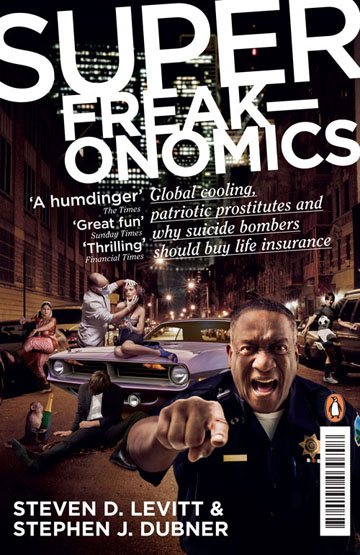 (Source: Popular Online) A couple of years after referencing Freakonomics, the destined sequel, Superfreaknomics, is out (or has been for the better part of a year)! The authors claim that it's better than the original, which I disagree with, if only because Freaknomomics was so novel. There's still lots to be mined in them thar hills of behavioural economics, though, their root of which is "humans respond to incentives", and which in academic form gives rise to stuff working in practice, but not in theory (from Chapter Three). While not redefining the borders of innovation (while being sold there), the book still deserves at least a quick run-through. The first chapter is positively conventional though, and that convention is that sex sells (but is not supposed to be sold - or in the wise words of George Carlin: "Selling's legal. F**king's legal. Why isn't selling f**king legal?"). The Oldest Profession  No Pleasure Without Pay (Source: Discworld & Pratchett Wiki) Field sociologist Sudhir Venkatesh is back at it again after his attachment to street gangs, which should make chatting (at a price, obviously) with, ahem, ladies of negotiable affection (LONA) a cakewalk in comparism. But some background first:
In effect, the greatest threat to ladies of negotiable affection are the ladies of unpaid affection, who achieve more selectivity over their partners, higher social status and intangible treats and trinkets in lieu of hard cash. Other amusing observations:
A "smart, capable, technically sophisticated (computer programmer), physically attractive, curvaceous and friendly blonde", she dipped into the market more out of curiosity than anything, and landed a nice dentist who lectured her on the do's and don'ts of the game on her first try - and gave her US$200 on top of that. She soon grew into the job, and happily discovered that even raising her hourly wage to US$400 didn't affect demand, which mainly came from married, middle-aged white men. If there's a take-home lesson from this, I suppose it's that quality affection is sadly rare. Or that all men are pigs. Whatever. [Skipping ahead to the last chapter, experiments at Yale with capuchin monkeys (who are probably good substitutes for humans given that they are fixated on food and sex) demonstrated that they can develop an understanding of money - using coins to trade for food - and inevitably hit upon the concept of using the coins to trade for sex too. So it seems that, in some strange genetic fate, monkeys are pigs too] 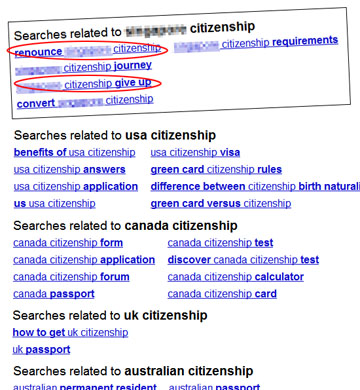 The Google verdict on citizenships (some names blurred for privacy reasons) [While we're on the case of supply and demand: The local authorities recently floated the idea of pushing some current Permanent Residents to take up citizenship. Immigration drives aren't all that rare, but the wholesale conversion of qualified (since the government wants them as citizens) non-citizens who are not all that eager to become citizens (since they are still PRs), is. This might provide some clue to the supply vs. demand status of citizenship here. Methinks there is much to be done at both ends of the equation] The Most Unpopular Professions The actual title in the book is "Why should suicide bombers buy life insurance?" (half-joking answer: so they can associate with people who are even less liked than them). Well, the serious answer is that a (unnamed, for security reasons) researcher did some data mining and discovered certain traits common with terrorists:
The trouble is that such an algorithm would have to be superbly accurate to be of any use - even a 99% accuracy would churn out millions of false positives (i.e. more-or-less honest citizens, from a population of say 300 million). Apparently, the researcher has tightened his down to the point where it discovered five near-certain terrorists, and about 25 more very suspicious people, a good job I would say. Unfortunately, this revelation of their distinctive banking habits should cause any would-be terrorist with half a brain to try and merge more seamlessly into the general populace (by, say, actually cashing some form of regular paycheck, and buying some frivolous things now and then). There's also the problem that one's name turned out to be one of the strongest predictors for suspected terrorism; Other things being equal, having both first and last Muslim names means that a person was 250 times more likely to be a suspected terrorist than a person with no Muslim names, which is certainly unfair on law-abiding Muslims. The obvious dilemma here is that the best strategy in terms of finding the most terrorists would be to focus the screening efforts on people who meet that ethnic/religious classification (but it can be argued that the drawbacks of resentment among those groups make such profiling not worth the effort). The other side of the coin, true random screening, would however inconvenience 80 year-old grandmas far in excess of their capacity for aircraft hijackings. Rock and hard place. [Outside observation one: Terrorism has, sadly, been extremely successful in imposing costs on democratic societies. For what amounts to spare change, they have managed to force governments to spend hundreds of billions on counterterrorism measures (sometimes almost laughable, like the requirement to remove one's shoes for inspection after Richard Reid's shoe bomb, and many other cases of fixing the pen after the sheep have escaped) The fundamental problem is that, as with assassins, the main difficulty in terrorism is not doing the deed, but getting away; A reasonably smart terrorist who can pick his targets and operate under pressure is almost certain to succeed. Think: How likely is it that a well-dressed businessman-type with a briefcase bomb would be stopped from getting on the subway in any major city? Answer: Almost never. The only direct solution would be economy-crippling comprehensive searches, huge losses of privacy and xenophobia if appropriate, which would in a way hand victory to the terrorists. Thankfully, the intersection between absolute fanaticism and operational intelligence is as yet not very big] [Outside observation two: More on data mining, or more precisely, extrapolation. A few years ago, I wrote on how information could be discarded from a facial image (through mosiacing) to make reconstruction impossible. Then, recently, I came across the technique of face hallucination, which guesses at the original face given a low-resolution input image (effectively a mosaic) - and pretty well, I would say! 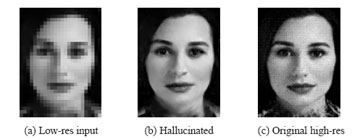 (Source: Face Hallucination: Theory and Practice) While this does not invalidate my point (since the reconstruction breaks down once the tile size is large enough, and facial features start out indistinct), it does illustrate the potential power that reconstructive techniques can conceivably attain - to be really safe from identification, blacking out the entire face would be ideal, at least until algorithms exist for generating hypotheses from facial shape] The Nicest Profession One of them would have to be a professor in economics, or psychology - few other jobs give the opportunity to give money away regularly in the name of improving humanity. The heart of the third chapter is about some laboratory games, most notably the classic Ultimatum and Dictator. In two-player Ultimatum, the first player proposes a split of a sum of money, and the second either accepts it, in which case the players share the money as proposed, or rejects it, in which case both leave empty-handed. If both players operate on pure logic, the first player would offer the second the bare minimum (say, a single penny), knowing that the second player would still accept it since it would be better than nothing. In practice, however, it rarely works this way (for a deeper explanation, refer to the Wikipedia link). Dictator is essentially the same as Ultimatum, except that the second (anonymous) player does not get any say. Therefore, the first player has absolute control over how much each of them gets. But in such a case, wouldn't the first player always claim everything? Well, the answer is... no! The experiment was repeated in many diverse societies, and people usually gave some part of "their" money away - 20% on average. It sure seemed that humans were intrinsically heart-warmingly altruistic (hooray!), until an economist called John List entered the scene and actively wondered why nobody had ever given him money anonymously. He added a wickedly simple twist to Dictator: Now, both players were given the same amount - but the first player could still give any sum, or if he chose to, take any sum from the other (still anonymous) player. The result: Only 10% of the participants gave any money at all, 60% took some amount from the second player, while 40% took all of the second player's money. Also, bear in mind that this was in an experimental setting, where the participants were aware of being watched (which List had found caused them to act more nicely). The story here seems to be that experimenters may ask the wrong questions, and in doing so too readily accept the answers they were looking for. [N.B. It does seem however that the final distribution of the money appears similar in both Dictator variants - so is it that, if given the power, most people are alright with others having a bit after all the redistribution is done, as long as they get the lion's share?] The saving grace was that when participants were made to work for their money, and led to believe that the other player had worked too, fully two-thirds refused to take a single cent from the other player (though 28% still did). Nothing like honest work to engender appreciation. To be continued...
Pretend punting challenge at P$317/P$300, thanks to Chelsea doing the honours. This week, the necessarily unbiased bookmakers have put Man United as more likely to beat Liverpool (1.65 odds) than Man City are to beat Wigan (1.70), which appears... strange. Surely City can't slip up again? P$100 on Man City to beat Wigan (at 1.70)
- travel - 10 September 2010 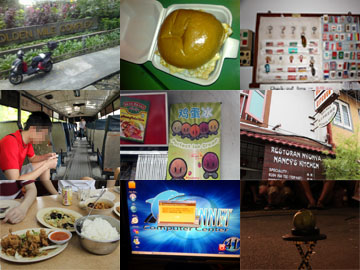 The hoped-for train journey became a bus ride, and the destination switched from Penang to Malacca, but the out-of-nowhere trip, kindly organized by law, was still on. Other participants: sel, alvin, colin. Point of departure: Golden Mile Complex [1] by Lavender MRT, only to be ferried all the way back west to the Second Link, in a demonstration of how several millennia of transportation has developed a system where one still can spend time and effort for next to no net displacement, at least to my grumpy 7 a.m. brain. The ride itself was uneventful other than the dual observations that being seated at the back, where the seats are higher, magnifies the effects of any bumps, and that Malaysian roads appear to... have more character than boringly flat Singaporean ones. Can't say the same for the scenery, an unending cascade of green interspersed with the occasional town. As before, there was a rest stop at Yong Peng, where most of us got a Ramly-type burger [2], and alvin sampled a mostly-bony chicken part. We were eventually set loose by the Hotel Equatorial in Malacca proper, though that was priced a bit out of our range; With the help of law's trusty copy of Lonely Planet's guide to KL, Melaka and Penang, we navigated our way to our lodgings at the Samudra Inn [3], where the proprietor was as friendly as the book promised (and we found a Chong watching TV). I would spend much time over the next couple of days browsing that tome, and learnt stuff such as the fact that that the Malayan Emergency was classified as such, despite being a bona fide civil war, for insurance purposes (alright, this is also mentioned in the second sentence on its Wikipedia article, but I don't remember reading about this in my history textbooks). The book does have its endearing innocent gaffes too, like when it referred to our Minister Mentor as the "ruler of Singapore", a lesson not to take everything at face value. 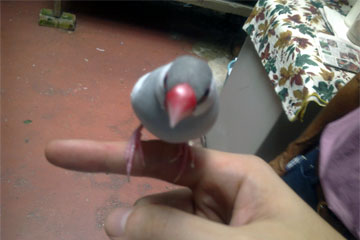 Who's a pretty boy, then? Huh huh? We soon checked into Rooms 2 and 7, and after registering our details and me having Somu's (the owner's) pet bird perch on my finger by request, we went about the first order of business, which was to settle our trip back home in two days. 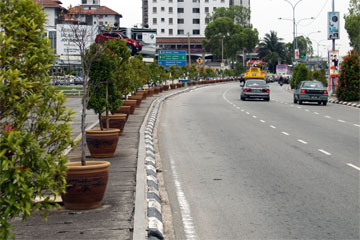 This is tricky (photo credit: law) It was then that we encountered another of the idiosyncrasies of Malacca, after hypothesizing earlier on that the town was sponsored by Mamee, so ubiquitous was the brand's logo. Somu informed us that the bus-stop into Melaka Sentral was one of the plant pots lining the road-side after taking a right turn, and we struggled mightily to locate the right one. Happily, the bus driver wasn't too particular, and for a flat rate of RM1 we were ferried [4] to the bus terminal, where we were fortunate to grab the last few seats on what appeared to be the only remaining service to JB two days hence. Next, we trudged about Malacca's Chinatown, with the crowds and lack of sidewalks making it an exercise in sharing space with traffic. There was no lack of streetside stalls selling edibles and trinkets, including a life lesson on the comparative value of cuttlefish snacks. The standout was Malacca's answer to gelato - a novelty ice-cream-in-egg-holder [5], with suggestions on how to reuse the holder. How could anyone resist that? Indeed, few could, and the sellers did a roaring trade, with one couple even asking us where it could be bought. The paucity of garbage bins was less admirable, though the streets were cleaner than I would have expected with the prevailing laissez-faire approach to waste disposal. After biding our time and a further short wait, we got admitted to Nancy's Kitchen [6], a Peranakan restaurant, for dinner - Malacca's supposedly the centre of the culture (made all the more famous by The Little Nyonya). I found the fare alright, but then I'm not much of a foodie. colin, who was probably the most accustomed to the offerings seeing as his father is a bona-fide Baba, described the candlenut [7] as an acquired taste, and I've to say I have not quite gotten it. Before that, we wandered about and encountered the Blue Dolphin Internet Cafe (~RM2.50/hour) [8], where we stopped for a welcome air-conditioned L4D2 session after not managing to get SC2 running. Seeing counterterrorists still dashing about shipping containers in cs_assault brought back memories of yesteryear. 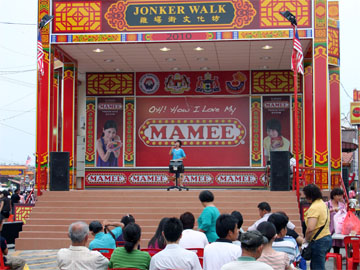 I want my Mamee... (photo credit: law) We returned to Jonker Walk in the middle of Chinatown at about 5:30 p.m., and stopped for chendol by a large stage set up in the middle of the street (see what I meant by Mameetown?) Unfortunately, the performers were all on the elderly side, though their vocals weren't half bad. They were also pretty cooperative, with some of them taking turns to serve as each others' backup dancers. Passing by the San Shu Gong building at the head of Jonker Street, we were assailed by loudspeakers extolling the "renowned superpower index finger" of Dr. Ho Eng Hui in three languages, and stopped to take a look. Others had the same idea as the good doctor prepared his area with lengths of yellow plastic chain, and soon a good-sized crowd had gathered, drawn by promises of coconut stabbing. There was a lot of banter before the main event, however, as Dr. Ho demonstrated his ability to crack a whip, swing nunchucks and send playing cards flying several stories high, in between teasing poor foreign "volunteers" and betting his head on them knowing who Bruce Lee was - which, despite the undeniable international fame of the one and only Dragon, makes it nothing short of incredible that Dr. Ho is still walking about with a noggin given his decades-long tenure. 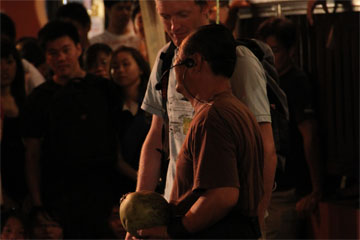 You wanna see my finger? (photo credit: law) He also managed to sell oodles of his miracle lotion at RM10 a bottle despite that being "not the point of his performance", but eventually he got around to having the poor Norwegian guy he drafted into helping pick out a coconut from the four he had brought, and passing it (the coconut, not the Norge) about for inspection. Finally, with the support of his two disciples, it was time for the big one. After tightening his pants and looking extremely serious, he raised his finger... and drove it into the coconut [9] several times, before leaving it inside and using his other hand as a hammer for good measure (Youtube). Well, what can I say? I will admit to wincing slightly at the performance - a coconut is hard, as anyone who has tried to open it to get a drink can attest to. The obvious pain aside, getting the technique to do the stunt sets Dr. Ho apart from peddlers who, say, simply cut themselves to demonstrate the efficacy of their product. On the other hand, poking through coconuts doesn't seem quite that impressive on second thought, but I would advise one not to say that to his face, at least before confirming that one's skull is indeed thicker than the common coconut. After spilling the guts of his nutty victim out on the road, Dr. Ho took a breather and liberally rubbed down his clearly-once-broken finger with the lotion, before proudly giving the finger to the crowd (one of the perks of the job, I would say). We cut and run after he spent twenty minutes on tutoring an Argentine ("Ah, Maradona!") on how to throw a coconut to him, and thus missed out on any firebreathing (so says the guidebook) he might have done. However, judging from his popularity (and brisk lotion sales), it's not hard to see why he hasn't yet hung up his finger. Next stop was the Dataran Pahlawan Melaka Megamall, a huge shopping centre, where we stocked up on toiletries and a 5.5L container of water, passed up on buying authentic football jerseys for about RM40, were treated to a confounding coin paddle magic trick (it turns out that it might simply be a variation on the fake flip illusion), and considered staying for a movie at the Golden Screen Cinema. Resident Evil didn't prove to be a big enough draw, though, and we soon made for the hostel, passing by what probably were attractively-dressed KTV hostesses en route. Tired, I passed up the bak kut teh supper. 11 September 2010 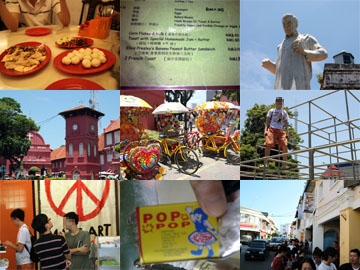 Historical Malacca isn't exactly a very large place, and we were rightly confident of covering the main sights in an afternoon. The idea of riding about on bikes was raised, but Somu advised against it as we would be liable if they were stolen, and the idea was dropped. We breakfasted at the Ichiban restaurant [1], famous for its chicken rice balls, not too far from the hostel. It turned out that they were approximately the size of the fishballs back home, i.e. not too filling given that we ate just three per person. sel soon discovered that the balls were already generously sized when he ordered noodles at our next stop, which sadly did not offer Elvis Presley's Banana Peanut Butter Sandwich as touted [2]. Coming across an A&W outlet in the mall, we couldn't resist having root beer floats, after which colin chose to appreciate Malacca in a more stationary fashion while the rest of us went traipsing about the centre of the old town. Clambered up St. Paul's Hill to visit St. Paul's Church, and its statue of St. Francis Xavier, who evidently had given one helping hand too many [3], perhaps in splitting coconuts? Nice breeze tho. 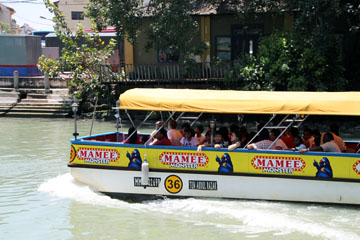 What did I say about Mamee? (photo credit: law) Next up was Christ Church Melaka and the Stadhuys [4], ostensibly painted red by the sensible Brits after they took over from the Dutch, to save on maintaining its previously white (and easily-dirtied) facade. Nowadays, the place is a trishaw depot of sorts [5], with the riders boasting an eclectic mix of theme songs, ranging from Lady Gaga to Eminem to Numa Numa. The local kids' playground [6] also got a visit. Chilled out at the tourist information office for awhile, before returning to walking the crowded streets. Found one of the three The Orangutan House outlets [7], featuring T-shirt designs by a local artist. Despite it being alvin's idea, I ended up as the only one who bought a shirt (RM30), which would be my only keepsake bar the egg holders. One of us did discover the forbidden joys of Pop Pops [8], those pinches of powder packed in bits of paper that could be thrown at the floor to produce a loud sound, and were fairly sought-after by kids each Chinese New Year as a very watered-down version of the traditional firecrackers, until the government got wind of the fun and banned them too. We spent an hour back at the Blue Dolphin, before seeking out the acclaimed Restoran Capitol Satay. Its reputation was such that, despite only officially opening at 5 p.m., there was already a queue stretching down the street by four-thirty [9]. We were fortunate to be relatively near the front, and managed to cover the perhaps twenty metres to the head of the queue in about an hour and a half, keeping ourselves sustained with law-sponsored pineapple tarts in the meantime. 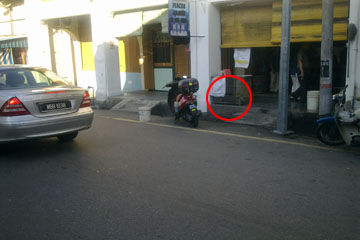 A show-me-the-bunny moment at the pet shop across the road It's hard not to be bursting with anticipation after the wait, and I soon realised that their satay was not the satay that I was used to. The staff set a pot of satay sauce down in the middle of the specially-made table to start things off, and we could pick out any of a selection of skewered food - the cheese hot-dogs deserve a special mention - to dip in the mix. The staff were nice enough to bring around special bonuses in the form of huge prawns and other delicacies, all priced at a flat RM0.80 a stick; I polished off 22 by the end. Looking at the mostly-empty establishments next door, and the steadily-lengthening queue, I felt it a pity that the restaurant did not have any of the "sisters, brothers or branches" that they so vigorously denied having. 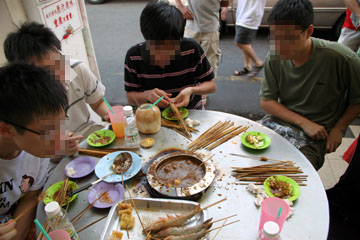 Anything left? (photo credit: law) We were done a while after seven, and did some shopping at San Shu Gong (tasty coffee samples), giving the wonderful Dr. Ho a miss this time. We then found ourselves at the Bamboo Hut Bistro at the Aldy Hotel by eight, where the Everton vs. United match was being screened. Rooney had been dropped, a relief given his recent performances, and doubly so as those performances could now be explained by his distress at having his extramarital dalliances exposed, rather than any permanent loss in class. 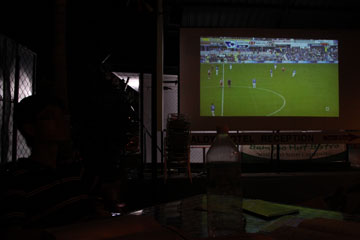 Not too concerned... yet (photo credit: law) The service was top notch, with staff even placing an electric fan for our benefit, and made my RM12 iced cappuccino with vanilla totally worthwhile. I was even mellow enough not to get too worked up when Howard pulled off a couple of ridiculous saves and Everton struck first thanks to an equally ridiculous missed bicycle kick clearance by Evra. The cosmic order was restored when United obligingly took advantage of some horrible defending to make it 3-1. Yes, Everton levelled it all up in the dying minutes, which meant that United threw away two points for the second away match running, but them's the breaks. It was then marathon Monopoly Deal time back at the hostel, as I discovered that the complementary wifi extended to our room as well, allowing me to keep track of the later matches on Soccernet and supply some background music. I also learnt painfully that having loads of dosh doesn't count for much in Monopoly Deal after the opening stages. 12 September 2010 Bye bye, Malacca. We got on the bus back to Sentral at the designated plant-pot-bus-stop, and availed ourselves of a hearty McDonald's breakfast. The S&S International Express bus rumbled into Platform 23 at ten as advertised, and I was pleased to discover that the seats were larger on the RM19 ride back as compared to the S$38 ride to Malacca. There would be no rest stop, which suited me just fine, and we arrived at Larkin by one-plus, where noodles and more Monopoly Deal happened. Got on SBS No. 170 to Kranji MRT (with a couple of breaks), where I was aghast to discover no newsagent. The End.
Monopoly Deal Discovered the charms of a nifty card game called Monopoly Deal recently, and spent several hours trying it with my cousins (who had some experience with it in social group settings/NS[!]). It turned out to keep much of the fun of the classic original, while upping the pace significantly; The description and basic rules are simple and listed on Wikipedia (also see the Hasbro demo), and therefore I will assume prior knowledge and continue on to the observations.
All in all, an addictive game, but best with at least three players - with two, it's often difficult to stage a comeback after falling behind in the first couple of turns. FourOPoly Deal? Hmm. 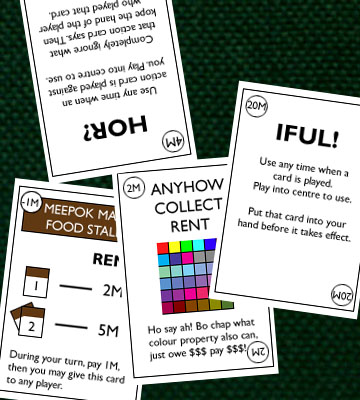 Sian, I tried to HOR? his Anyhow Collect Rent but he IFUL it (Here, thanks to occ aka mm for organizing the San Katong Laksa steamboat outing, and too bad to tpk) The Singaporean Deal Some days ago, the government announced the National Service Recognition Award (NSRA), which effectively grants newly-minted NSmen S$9000 (S$10500 for commanders), and slightly less for NSmen who have already completed some of the milestones (and unfortunately, nothing for those who have already completed it all). Not surprisingly, there have been some rumblings online about how the award "cheapens citizens' contributions" and is even "insulting", in such diverse (well, ok, maybe not) forums such as the Straits Times discussion board and the not-very-pro-incumbent-regime Temasek Review. The major complaints are that:
Taking these one by one - for the first point, I have to say that NS allowances are rather piddly, even after recent increases; Most NSmen should expect to get around S$500 a month for their entire service period (they do get three hots and a cot), while even officers mostly top out at about S$1000. In comparism, a McJob at S$4 an hour would pay S$640 for an 8 hour day, weekday-only workmonth, and I daresay a motivated and hardworking person with some skills would be able to make double or triple his NS pay in comparably-demanding civilian job(s). This may not be too much of a sacrifice for the moderately well-to-do, but can be quite a bother for poorer citizens, especially if the family relies on the soon-to-be NSman as main breadwinner. Taking this further, it can be argued that the two years of service has a compounded effect on citizens' future earnings, which can conservatively tot up to some S$150000 by age 40 (well, the author of that article doesn't include the NS allowance in his table, but the point stands) It is also true that tacking money onto an award might change one's perception of a task (see the The Induced-Compliance Paradigm) - but then would paying market rate for NS inculcate more pride (servicemen get the recognition of being paid closer to what they are worth), or less (since it's now effectively just another [forced] job)? [Sidenote: Personally, I think it would be interesting to see how well a completely voluntary National Service term would work - would those might later claim that NS has taught them a lot etc, still sign away two years of their lives if they had the choice? Would the love of country/sense of responsibility/social stigma of not contributing be sufficient to inspire/shame the majority of young men into the armed forces, or would personal pragmatism prevail, and make passing up this presentation of patriotism prudent? Some questions may best be left unanswered] Second point: Yes, it's unfair to past batches of reservists. While nobody has quite been able to solve this problem in its general form yet (see the NUS context), in this case it shouldn't be much more difficult to simply give the award to all NSmen past or present (since NS only began in 1967, I daresay the vast majority of servicemen are still alive), and adjust the monetary component accordingly (or even just give a token sum). While a couple of retired servicemen have come out to say that it doesn't quite matter to them and that they have moved on, it isn't hard to imagine that at least some of the old guys could really use the money; As to why the award (which must have been designed by extremely-smart policymakers) is structured this way... is anybody's guess. Leading into the third point, a possible, if extremely cynical, conjecture is that the younger guys are less beholden to party loyalties, and therefore shaping the award to benefit them the most would get the most bang (for bang, read votes) for the buck. While the truth is likely not so cruel (I hope), it is hard to believe that the basic well-timed-goodies-for-support exchange was completely absent from policymakers' minds - because it does work much the same way, almost everywhere, unless the goodie-giver is extremely disliked. And as to the fourth and final CPF-as-black-hole complaint - I admit that I knew very little of the CPF, other than the fact that many netizens didn't think much of it (which may be a skewed selection of opinion). A bit of reading up reveals that it's a form of social security for Singaporeans (alright, I had that figured out), and that both employers and employees (are forced to) pay into the employee's CPF account, which is mostly used for housing, retirement and insurance purposes. Sounds pretty reasonable - so why the hate? Basically, the issue is the government directing how one's money is being spent (or not). True, all governments do that by collecting all sorts of taxes, so by itself this is nothing new (or popular). Indeed, whichever way one carves it up, the CPF is still better than a tax, since it's still technically your money, even if you can't quite use it the way you want to - at worst, it goes to your next of kin upon your demise. Still, it stops people from spending their money the way they want to (which is the only way it ought to be spent, after all). Oh, of course, if one desires to be a model citizen and buy "subsidized" public housing (another common grouse) and guarantee oneself a pension so as not to burden society, the CPF would mostly do what they would have done anyway. The yield of 2.5%-4%, while not out of the ordinary, doesn't look too bad compared to say 30-year US Treasury bonds (currently at 3.78%), at least until the boom years return. However, given that the average return of the stock market has been known to be 8-10% over the long term (a not insignificant difference from even 4%, after compounding - you do the math), it might be understandable that some citizens would at least want to be allowed to choose that option. But perhaps the biggest concern is the, let us say translucency of the whole gig. In some reasonably (in)famous words, "Where is the money?", the full answer to which not even an elected president could get. This is also before taking into account the continually shifting goalposts where retirement (and now, property) is concerned, or if it will even come. So, another policy ends up in the netizen could-do-better bin. But, objectively, I believe Singaporeans have got a good deal. Eh, wait! Knn, how can? Gahment bootlicker! The Raw Deal - John Kenneth Galbraith (not that liberals are all that selfless...) Let's see - to begin with, the food's good, crime's low, place's clean and corruption's virtually unheard of. Frankly, there are far, far more places where average conditions are worse than Singapore, compared to where they are better. Which doesn't mean that there's nothing to complain about - but what about the favourite destinations of emigrating Singaporeans (about ten thousand annually): the U.S.A, Canada, Australia, New Zealand, etc? Clearly they have their own set of pros and problems - yes, one might gain political and personal freedoms and space and a relaxed lifestyle and welfare, but in return one gets to dip into a mixed bag of guns and drugs and poorly funded schools and taxes to support that welfare, depending on exactly where one settles; One might not see much of the darker side in upscale districts, but this is as disingenuous as a resident of Sentosa Cove claiming that Singapore is as good as it gets. 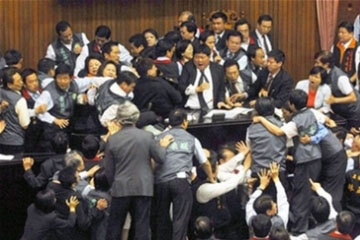 Freedoms freely expressed (Source: Teamexpansion.org) And ironically, Singapore's emigrants being the immigrants of those countries, it turns out that at least some of the citizens of the U.S. and Canada and Australia etc have similar doubts to those that some locals hold about mostly-mainland-Chinese newcomers; Just as Singaporeans bemoan fresh arrivees from taking their jobs for less, others elsewhere complain in the same manner. The grass is greener everywhere, and everywhere people wonder why they have to give up a share. Alright, Singapore may be laxer in doling out actual citizenship than say the U.S.A, but hey, we're the most popular by percentage, so why not make people happy, right? In fact, if one knows the right websites to visit, it is not hard to get the impression that any given government is a self-serving, little-man-ignoring, hopelessly incompetent collection of greedy underqualified morons. Mark Twain: "Suppose you were an idiot. And suppose you were a member of Congress. But I repeat myself." But that's what governments do - if everyone agreed on the issues, there would be no need for politicians, parties, or power blocs. Sadly, they don't, and it is almost a given that there will be unhappy citizens. From the economy to gay marriage, military action to immigration policies, the man in the street is sure that he has The Answer. Politics is a strange beast, though. I doubt that it's a science, whatever university departments say, and it barely looks like art either. Many of the causes and effects are fiendishly hard to disentangle on a national level, and since a perfect state has yet to exist, there will always be dissent. Still, it appears likely that there are "better" and "not as good" states - so how do we tell them apart? This is difficult too, given that people prize different values (one person's wish for an idyllic, less crowded lifestyle may be at odds with his neighbour's drive for educational achievement and economic prosperity). While admittedly a very crude measure, I think that the degree of actual action taken against the current government is a possible indicator (aside from health and life expectancy etc, in obvious negative examples). When people feel that they truly have been grossly mistreated, or driven into desperate straits, mass violence is the inevitable eventual result. It might sound strange, but Singapore is hardly the only developed nation that takes action against protestors (it has to be said that Singapore is good at it); Students of history can observe that Singaporeans were far from averse to rioting, despite the very real risks of injury and arrest (surely such demonstrations were not legal then as now?). Indeed, other than the luckless Dr. Chee and his associates, small vigils and the like appear tolerated. My conclusion is that the majority do in fact think that life here is, on the balance, alright. Not quite ideal, and thus open to the usual (often faceless) complaints, but sufficiently tolerable as not to warrant any more concrete efforts. Of course, this is not to say that satisfaction, or even gratefulness, must be due our well-renumerated administrators... [To be continued, maybe] The Double Deal 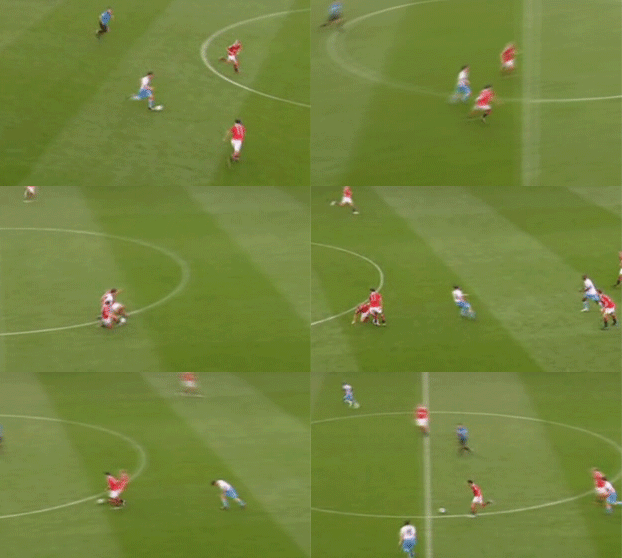 Double Take (Source: Redcafe.net) May they never retire.
|
|
|||||||||||||||||
 Copyright © 2006-2026 GLYS. All Rights Reserved. |
||||||||||||||||||