|
[ June 2007 ] | |
|
| |

|
|
|
|
TCHS 4O 2000 [4o's nonsense] alvinny [2] - csq - edchong jenming - joseph - law meepok - mingqi - pea pengkian [2] - qwergopot - woof xinghao - zhengyu HCJC 01S60 [understated sixzero] andy - edwin - jack jiaqi - peter - rex serena SAF 21SA khenghui - jiaming - jinrui [2] ritchie - vicknesh - zhenhao Others Lwei [2] - shaowei - website links - Alien Loves Predator BloggerSG Cute Overload! Cyanide and Happiness Daily Bunny Hamleto Hattrick Magic: The Gathering The Onion The Order of the Stick Perry Bible Fellowship PvP Online Soccernet Sluggy Freelance The Students' Sketchpad Talk Rock Talking Cock.com Tom the Dancing Bug Wikipedia Wulffmorgenthaler       |
|
bert's blog v1.21 Powered by glolg Programmed with Perl 5.6.1 on Apache/1.3.27 (Red Hat Linux) best viewed at 1024 x 768 resolution on Internet Explorer 6.0+ or Mozilla Firefox 1.5+ today's page views: 620 (35 mobile) all-time page views: 3906341 most viewed entry: 18739 views most commented entry: 14 comments number of entries: 1295 page created Thu Oct 22, 2026 18:50:58 |
|
- tagcloud - academics [70] art [8] changelog [49] current events [36] cute stuff [12] gaming [11] music [8] outings [16] philosophy [10] poetry [4] programming [15] rants [5] reviews [8] sport [37] travel [19] work [3] miscellaneous [75] |
|
- category tags - academics art changelog current events cute stuff gaming miscellaneous music outings philosophy poetry programming rants reviews sport travel work tags in total: 386 |

| ||
|
...I wrote a timeline in red ink while Hong Kong was still British territory, and in blue ink when China took over. Don't ask me why. I lost that piece of paper a long time ago. I recall reading about that Handover in a Bookworm Club book when it was still to come in the future. Darn, I feel old again.
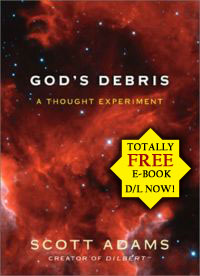
- philosophy - In resuming the discussion on Scott Adams' God's Debris (Here's Part One), it may be instructive to consider some readers' comments from the book's Amazon customer review page. As is usual, the glowing, five-star feedbacks gushing over the work in question are not as interesting as the put-downs. Some were evidently penned in a hurry: "From my reading experience was made of the following 20% stuff I already knew 70% interesting but useless, and thus I ignored it 30% really useful information that I will write down and review many times" Maybe there's some category overlap going on there. Some sniffed at Adams' perceived pretensions: "The only thing I can really say is that this book is absolute garbage. It's borderline plagarism [sic] (here, let me steal the writing style from Plato and move on), except that none of the ideas presented in this book make any sense when compared to the Republic..." 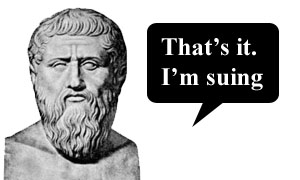
Plato is NOT amused. Um, so it's a dialogue. True that. Then again Plato likely adapted the form from earlier poets, and if this were to be considered plagiarism the libraries of the world would contain one comedy, one tragedy, one biography... you get the idea. I admit God's Debris isn't going to be challenging the Republic in philosophical canon anytime soon, though. "And I thought it couldn't get worse than the Dilbert cartoons, but this is worse. Much worse." Same reader that gave the last quote. Evidently not a fan. "...Otherwise, the ancient wise man comes across as an enthusiastic but naive youth. A "man who knows everything" would always include the Michelson-Morley experiment in an explanation of Special Relativity, and be numerate enough to avoid statements like "if you flip a coin often enough, eventually it will come up heads a thousand times in a row" (The odds of 1,000 consecutive heads is 1/2^1000 =~ 1/10^301. If every person presently alive on earth flipped a trillion coins a second until all conventional matter has vanished from the universe (10^124 sec), the chance of one person getting 1,000 heads in a row is still worse than 1:10^270!)" I'm not too well-versed in the intricacies of the M&M experiment, but if Einstein himself could use "When a man sits with a pretty girl for an hour, it seems like a minute. But let him sit on a hot stove for a minute and it's longer than any hour. That's relativity." as an introduction, that's enough for me. 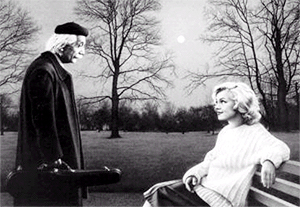
"Ma'am, would you give me a minute?" (Source) The objection to the coin flip assertion is kind of strange, though. The reader appealed to practical considerations in rebutting a wholly theoretical statement, albeit with an appeal to the currently predicted lifespan of the Universe. From a mathematical point of view, though, for any finite X, the probability of a coin coming up heads X times in a row is definitely calculable, and in fact the statement that "if you flip a coin often enough, eventually it will come up heads (some gargantuan number) times in a row, (some gargantuan number) of times" is perfectly valid. This reminded me of an article in which a professor described one of his students as a whiz at numbers, who could solve extremely complex problems, but who steadfastedly refused to consider that numbers could have more digits than were displayed on his calculator. Quite a large blind spot maybe, but happily one that may well be overlooked in some specialties; Perhaps most people have some such "blind spots" of their own... Adams' challenge to "figure out what's wrong" received its fair share of attention: "For the record here are some of Avatar's errors of fact: (p19) magnetic fields can't be blocked; (p19) gravity propogates [sic] instantly; (p22) we don't understand how electricity travels; (p61) there is no friction between the Earth and the Moon (the statements about gravity and the Moon are wrong in multiple ways); (p66) the theory of evolution is a "concept with no practical application." A bit of research suggests that in fact, magnetic fields can't be blocked with non-magnetic materials, with a possible exception. As for gravity propagating instantly, I can't detect the Avatar actually implying "instantly" on page nineteen - but at least that's a fact. As for not understanding how electricity travels, it is true that we can explain - up to a point - electricity. We can talk about charge, about ions, electrons, conductors; But up to a certain depth, even the best scientists begin to hem and haw. If you asked, "what is fire", you would get responses about "chemical reactions", "oxidation" and the like, but what it is... well, suppose we change the topic? This may be to a degree an issue with language itself, with concepts being built on others - i.e. a Pegasus is a winged horse; I have seen wings, and I have seen a horse, so I can imagine a Pegasus. This may lead to circular references, which could be expensive - cue a man who once sought legal advice, and was told that he should prepare a will, because "if you die without a will, you would die intestate." Curious, he went home and picked up a dictionary, and lo and behold, under the entry for intestate: Dying without a will. Back to the novella: Page 34. "The human brain is a delusion generator. The delusions are fueled by arrogance - the arrogance that humans are the center of the world, that we alone are endowed with the magical properties of souls and morality and free will and love. We presume that an omnipotent God has a unique interest in our progress while providing all the rest of creation for our playground. We believe that God - because he thinks the same way we do - must be more interested in our lives than in the rocks and trees and plants and animals..." "...Practicality rules our perceptions. To survive, our tiny brains need to tame the blizzard of information that threatens to overwhelm us. Our perceptions are wondrously flexible, transforming our worldview automatically and continuously until we find safe harbour in a comfortable delusion." "...It is absurd to define God as omnipotent and then burden Him with our own myopic view of the significance of human beings..." This is something I always thought was kind of strange. Once, when we were two years old, we may have reckoned ourselves as obviously the most important thing there is and ever was. Most people grow out of that as individuals, but in their own societal groups, humans by and large retain a certain chauvinism, a subconscious validation that "we" are the centerpiece of Creation. The least bit of rational thought would reveal, as stated earlier in the novella, that joining the "right" religion is at best a slightly better than one-in-three chance, and at worst nearly impossible. How? So people usually gravitate towards religions their family or friends are in, figuring that even if it sinks, at least they're all in the same boat (a pleasant gesture); But in the same way that teens fooling around don't really think they'll be the ones to get saddled with a kid or some icky disease, that smokers regard lung cancer as something that "happens to other people", that investors assume that there will always be a greater fool to offload onto, it appears a congenital defect that we rate ourselves as somehow, special, and that our religion cannot possibly be a false one. Unbelievers and infidels are, almost by definition, the other people. 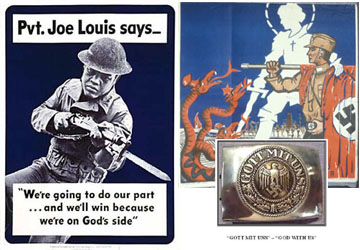
In foxholes, all think that the Big Guy's on their side (USA and Nazi WW2 propaganda) The desire towards good, towards virtue, is the most noble of passions; 孟子认为人性本善,荀子认为人性本恶, and i lean towards 孟子. But, as the ancient Greeks questioned, "Is what is moral commanded by God because it is moral, or is it moral because it is commanded by God?" The apparent dilemma is that if deeds are commanded by God because they are moral, then men need not tarry by worshipping, but concentrate on living a moral life, since morality and virtue are independent of belief; If deeds are moral because they are commanded by God, then if his will be to kill, then murder would be good (cue Abraham and Issac). As the example of the posters above illustrate, morality has little bearing on the invocation of the Divine - mere obedience without independent thought, harnessed by the malevolent, is the cruelest possible mockery of our innate desire towards good. Here, a slight complication arises: There are many widely accepted interpretations of God available in this world, and many of them are, how shall I put it, rather unfriendly to other interpretations. So in this admirable quest, a usual outcome is that one is introduced to the God(s) of one's loved ones, and quite often I believe this is the end of the story; Of course, this is not always the case, and sometimes we see within a family a colourful sprinkling of faiths, and behold Christians, Buddhists, Taoists, etc coexisting peacefully under one roof. Now, this is all well and good, but what do we have? In many religions, the adherents are admonished to "have no other Gods before Me", or some version thereof, with the implicit (or explicit) claim that all other religions are falsehoods. Now, a gentle believer might be sorely troubled, at his or her loved ones not following the one True way; This is not helped by a very sincere insistence of the extremely unpleasant consequences in the hereafter of not joining the correct religion, which is to say, the speaker's. Then again, this is perhaps to be expected. Let us imagine a scenario: A seeker after God approaches a holy man. "Guru, what do you believe?" Guru: "Oh, I believe in ..." Seeker: "Ah, so yours is the only way to God?" Guru: "No, there are many Ways to Him." Seeker: "I see." (Moves on) Seeker to Guru 2: "Guru 2, is yours the only way to God?" Guru 2 (with utmost conviction): "Yea, my son. Mine is the one, the only, the highest, the holiest God. If you do not believe in Him, you will burn for all Eternity, but fear not! Just accept Him, and you drink the milk of Paradise!" No contest there. This was recognized by the French philosopher Blaise Pascal, who proposed a rational gambit: Believe in God, and (your particular conception of) God exists: Infinite reward in the afterlife. Believe in God, and God does not exists: No gain, no loss. Do not believe in God, and God exists: OUCH! Do not believe in God, and God does not exists: No gain, no loss. Again, this is complicated by the inconvenient existence of multiple possible visions of God, but somehow I imagine that the true God would be rather unimpressed - there seems to be a poetic justice to Him turning his back on those who seek Him for reward. Richard Carrier pushes the case for God desiring honest skepticism and abhorring blind faith, in his The End of Pascal's Wager: Only Nontheists Go to Heaven: "It is a common belief that only the morally good should populate heaven, and this is a reasonable belief, widely defended by theists of many varieties. Suppose there is a god who is watching us and choosing which souls of the deceased to bring to heaven, and this god really does want only the morally good to populate heaven. He will probably select from only those who made a significant and responsible effort to discover the truth. For all others are untrustworthy, being cognitively or morally inferior, or both. They will also be less likely ever to discover and commit to true beliefs about right and wrong. That is, if they have a significant and trustworthy concern for doing right and avoiding wrong, it follows necessarily that they must have a significant and trustworthy concern for knowing right and wrong. Since this knowledge requires knowledge about many fundamental facts of the universe (such as whether there is a god), it follows necessarily that such people must have a significant and trustworthy concern for always seeking out, testing, and confirming that their beliefs about such things are probably correct. Therefore, only such people can be sufficiently moral and trustworthy to deserve a place in heaven--unless god wishes to fill heaven with the morally lazy, irresponsible, or untrustworthy. But only two groups fit this description: intellectually committed but critical theists, and intellectually committed but critical nontheists (which means both atheists and agnostics, though more specifically secular humanists, in the most basic sense). Both groups have a significant and trustworthy concern for always seeking out, testing, and confirming that their beliefs about god (for example) are probably correct, so that their beliefs about right and wrong will probably be correct. No other groups can claim this. If anyone is sincerely interested in doing right and wrong, they must be sincerely interested in whether certain claims are true, including "God exists," and must treat this matter with as much responsibility and concern as any other moral question. And the only two kinds of people who do this are those theists and nontheists who devote their lives to examining the facts and determining whether they are right." How convincing this argument is, I leave the reader to decide; But I would venture that the very last thing an omnipotent Godhead wants is for people to carry his balls (though this may not sound so implausible to people who do like their balls carried...) To be continued again...
- art - 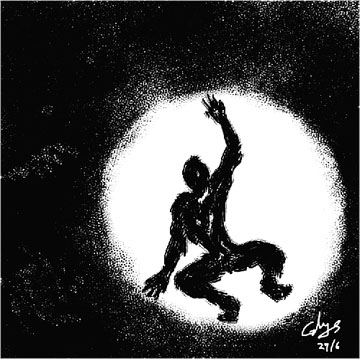 "We are all in the gutter, but some of us are looking at the stars" - Oscar Wilde
- gaming - poetry - Dug through my personal subfolders today, and found the remnants of some projects that have faded away as vaporware. The bones of more such potentials, crushed beneath the heartless wheel of the development cycle, surely lie deeper beneath the surface; But for today, let us inspect the remains of two that showed so much promise - in fact, the first one was actually completed! 
Misleading, we all went Uni Presenting FourOPoly, totally no relation to Monopoly. Except the properties. And the Chance cards. And the Public Utilities. And the Jail. But hey, it has Class Events instead of the Community Chest, and a Free Toilet (so important in this day and age for a First World society!) instead of Free Parking (for reasons of realism), and more squares than Monopoly to adequately tribute my old classmates! Would have forgotten all about it after a quarter-baked effort to implement an online version, together with all the in-jokes, had Law not mentioned Settlers Cafe and board games. I really should self-finance a few copies of FourOPoly and donate them to the Settlers and Mind Cafes one of these days. After I raise a few millions bucks for a legal defense against Hasbro. One innovation was the use of dice rolls to decide Chance and Class Event outcomes, which prevents the loss of cards, and more importantly saved me from printing them out back in JC. Stuff like "Caught playing cards. Go do CS" sure brings back memories :) I vaguely recall preparing for a FourOPoly II: Top of Ivory Tower expansion back then, with a vertical tower on top of the Free Toilet square. Wonder if that qualifies to sufficiently differentiate it from Monopoly, like the Late for the Sky variants. One trial run back in JC suggested that the property prices and rents needed some balancing, but I guess we'll never know how it would have turned out, now. Another never-completed project was Sents vs Skuge, a text-based MMORPG set in the DotA universe - which reminds me, it is possible to connect to SG games from Taiwanese airports and Caltech, as proven by csq :P 
Crude concept art for login 
SvS GUI I was programming this on my days home from fulfilling my NS disruption-resumption dues last May-June (that's what NS life can do to you), after I completed my 4O Dice game. Lost interest abruptly after ORDing, and the November crash of my computer nearly wiped out the in-game graphics. Won't be continuing development anytime soon... Some poems were prepared to introduce the chosen heroes, including many hints on their abilities and characteristics - DotA players, this shouldn't be hard :P (Some names and titles removed to avoid making it even more blatantly obvious than it already is) An Elvish knight of a human House, [Name] bows to no lord or Crown. Only by Paladine shall he be judged, One of God's chosen, high in regard, Whose honour is ever his to guard. Skeletal warrior of unholy might, Smites with Grond all good in sight. His bleeding blade, life doth drain, His restless soul no death dare claim, While magic yet flows in unseen veins. Leader of a scattered centaur tribe, He suffers not a patronizing jibe. Half stallion and half son of Adam, And all muscle in a two-ton frame, Containing a heart so brightly aflame. No mere zombie, this immense hulk, Rotting flesh sewn into a single bulk. With a stench to repulse, And a meathook to announce, Fresh meat for the [Title] to take out. The Perfect Blade, Unwavering Hand, Best swordsmaster in all known lands. Like a biting storm in his rages, This Orc heals even as war he wages, Against the fools who duel him unaided. Pariah warden, lone child of Night, A shadow's whisper removed from sight. Poisoned dagger eased into the back, The [Title] appears, viciously hacks, Coup de Grace! Another's in the bag. [Race] huntress of a righteous calling, Arrows hit harder under her bidding. Say nothing against the wily [Title], Her icy shafts know no strangers, Even as one suffices for the lesser. Elite Marksman, cruelly laid low, Only dry bones left to pluck his bow. A foreboding breeze in times of need, Upon his followers a pact to feed, The living fire that fuels his deeds. Casting infernoes for food and fun, [Name]'s hot in more ways than one. Arrayed in light, dragon-served, She slays those who richly deserve, A Laguna from Mistress [Name2]. Warlock by great Demons so prized, Three tools to take a mortal's life. A simple curse to turn to sheep, Wicked spikes, that the brave may weep, Finally the Finger, to send down deep. Sayer long gone, whose spirit remains, To all who breathe, a dreadful bane. The cultist speaketh to those who wake, What Death once gave, He will unmake, Under bats and specters, All will break.
The hours seem to slip by so readily :/ So here's some more random stuff - while at the NUS basketball courts, I noticed some workers maintaining the floodlights using some sort of portable winch box, thus lowering the top half of the pole down to ground level for them to inspect at their leisure. 
Fun with MS Paint I vaguely remembered then that the (older) floodlights at some other place instead had horizontal handholds jutting out of their top half for the worker to climb up and do his job. Now, if you ask me, bringing work to meet one is far better than going out of one's way to find work, not to mention safer too. There are of course disadvantages too - constructing the pole to be able to fold in half probably is more challenging to engineer, or at least more costly; It might not be possible to reach the lamp without the right gear, while all one needed was a ladder and a good grip in the past. Then again, in a world where a horde of Secondary Four students can climb their way up a eight-storey high fire lookout tree without any precautions whatsoever, heights shouldn't be that much of a concern... After basketball, I was struck with a funny idea - what would it take for a private citizen to send a token to say, the Moon? The USA's Apollo program cost over a hundred billion dollars (adjusted for inflation), but that included the complication of getting fragile lifeforms there, and back. However, unmanned landings haven't been that hot either, with only the usual suspects like the USA, Russia, Japan, China, India and Germany involved. Why? Money, most probably. Getting some rocket to the Moon is surely possible, but it wouldn't be profitable. The Americans bankrolled Apollo mainly to one-up the USSR at the peak of the Cold War, and after that first giant step for Mankind (and general snootiness versus the Commie Ruskies), the administration probably realised that there were more urgent uses for those billions. Could a tiny payload, say a kilogram or so, be sent to the Moon on the cheap then, say in the range of a few tens of thousands of dollars? Considering how a huge bleeping (non-reusable) launch vehicle is required to boost the comparatively tiny spacecraft to the edge of the atmosphere, one must wonder if there is an easy way to lift the payload to the edge of the atmosphere. A hydrogen or helium balloon, maybe? The nice thing is that there is no air resistance in space, so all the hypothetical rocket needs to do is to work against gravity, a force that diminishes quickly as the rocket gets further away. Also, since there's no provision for the rocket to return, no additional fuel needs to be catered for. One could imagine a teeny flag popping out of the spent rocket just for bragging rights. Silly, maybe. But then I Googled "launch rocket with balloon", and found that some guys at Cambridge are doing it, at least the "into space" part. Best of luck to them.
- sport - While Part Two of "Logic" is in the making, here's a recount of the past few days. Ate some bazhang, Owed myself a few dozen chinups (I didn't know I would walk into my room that much), and watched the simultaneous La Liga title deciders at 3 a.m. on Monday. Real Madrid only had to win against Mallorca to wrap up the championship, while Barca travelled to cellar team Gimnastic de Tarragona needing Madrid not to win to have a chance. FC Sevilla had a dim hope, but were dependant on both frontrunners failing to win. Gimnastic vs Barca on Channel 21, Madrid vs Mallorca on Channel 22, a cousin to watch it with, McDonalds home delivery (a first!), what more could I ask for? An answer to how home delivery is profitable for the establishment, maybe. Supposedly pizza guys in the USA use their own vehicles, and get a small margin for fuel; Assume the whole delivery charge (~$2) goes towards the delivery guy's wages, and a typical delivery guy makes an average of 20 deliveries a day, 20 days a month - $800, which sounds about right, perhaps on the low end. Wonder how efficient their bikes are... I'm mostly neutral on the merits of Real Madrid vs Barca, if slightly biased towards the latter due to their reputation for attractive football. Madrid however would have to stump up a couple of million Euros to Man Utd if they won the title, due to some nifty clauses in their ex-United duo's (Beckham & Ruud) contracts. My cousin, also a United fan, supported Madrid for the night for this reason, and just to be contrary I rooted for Barca. At this point I may digress on how I choose a sportsman or team to get behind when encountering them on TV, for it just isn't fun to plonk oneself in front of a titanic struggle as an uninvolved spectator. For duels, generally the underdog gets my vote, with Jordan and Schumacher being notable exceptions; For teams, I'm partial to those wearing some green (hence the soft spot for the Celtics, both the Boston and Scots soccer incarnations), or first impressions, thus egging Juve on in the absence of other considerations. If there's nothing between them, I'll just support the currently attacking team. But if you're after an EPL team to support permanently, Back to the matches - Mallorca and Barca went 1-0 up, and it looked as if United would be out of some moolah. There was some pre-game debate on ethics when Messi (of Barca) mentioned that his club should really offer cash incentives for the Mallorca players to win, given that they didn't have much other than pride to play for. Of course, they're supposed to try to win anyway, so is a third party encouraging them to do that morally right? A rejoinder was that if teams were to get used to being paid extra to win, what would stop them from accepting commissions to lose in future? Sometimes football's a dirty game... Barca continued slaughtering hapless Gimnastic, quickly piling up three goals, though in fairness Gimnastic had their moments. They aren't bad per se, just not quite in Barca's class. The Spanish Primera does appear to lack a certain... shall we say full-bloodedness in their tackling, resulting in a more freely flowing game, though this may just be attributed to the top clubs being on display. But a hundred goals against Gimnastic meant nothing if Madrid were to win as well, for Madrid had the edge in their head-to-head meetings - so as the Barca game dwindled into insignificance after their fourth goal, it was Madrid on the telly almost all of the time. Beckham, who had earlier hit the angle between bar and post with a looping free-kick from wide of the penalty area, was taken off, and in came Reyes with only about half an hour to go. And who would have bet on the on-loan Arsenal man to sidefoot an equaliser in at the near post so quickly? A draw wouldn't be enough, though, and Madrid attacked with additional fury. Being at home does have its advantages, among them the speed of the ballboys at supplying a replacement ball after the current ball goes out of play - In one instance, a Mallorca player's shot had barely gone out of play when a second ball was thrown to Casillas to take the goal kick, all in the blink of an eye. Can't say the commentator did much to add to the atmosphere, what with eighty percent of his spiel being enunciating the name of the player who happens to be in possession, with precious little of the banter heard during EPL matches. Different strokes for different cultures. Well, it ended with a save off a corner kick being blocked into his own net by a blur Mallorca defender standing at the post, and Reyes adding a third to no doubt boost his standing with his prospective new employers; This turn of events transformed the Barca supporters and bench into some of the saddest folks ever to watch their team win by four goals, as seen on the other channel, gave Beckham and Ruud their first silverware with Real, and fattened the United coffers to the tune of a million-odd pounds, which should pay the wages of the newcomers (Hargreaves, Nani and Anderson) for a couple of months. All in all, a good morning on balance, I suppose.
- philosophy - It's more than halfway through Super Slack Week. Ahhhhhh. Here's the book recommendation of the moment:
Spoiler warning: Plot and/or ending details follow. First off, in the author's words, it's a "132-page thought experiment wrapped in a fictional story". There's "no violence, no sex, no offensive content (not to everyone, as it turns out)", and worst of all, no Dilbert. But don't delete it yet. There's a PG-14 rating slapped on it, so it can't be all snooze-inducing. Also, "The story's central character has a view about God that you've probably never heard before. If you think you would be offended by a fictional character's untraditional view about God, please don't read this." Fair warning. Ready? Actually, it would probably be best if you actually read the novella before continuing with the blog post, but I accept that probably ain't gonna happen. So let me spoil some of it for you. The first deep question posed is whether, when a person carries a package to a house, the person is delivering the package, or the package is delivering the person. I would say it's semantics, so let us move on. The next question is that of the compatibility of the omniscience of God versus the free will of humans, or in slightly fewer words, theological determinism. The apparant paradox is: 1. Being omniscient, God knows all the future. 2. People have free will. 3. From (1), since God knows the future, all our choices are already determined. 4. From (3), people cannot be said to have free will. 5. Therefore (1) and (2) are mutually exclusive. The Abrahamic religions appear split on this, even within themselves; Calvinism (no, not he of the Calvin and Hobbes fame, but rather after John Calvin, whom the Calvin of Calvin and Hobbes is named after) refreshingly asserts that "...[predestination is] the eternal decree of God, by which he determined with himself whatever he wished to happen with regard to every man. Not all are created on equal terms, but some are preordained to eternal life, others to eternal damnation; and, accordingly, as each has been created for one or other of these ends, we say that he has been predestinated to life or to death." I.e, who God saves is the business of God himself - One of the five points of Calvinism is "God's choice from eternity of those whom he will bring to himself is not based on foreseen virtue, merit, or faith in those people. Rather, it is unconditionally grounded in God's mercy." So one can try one's honest best to do good in this world, yet be condemned to Hell. Without any pretension, I have to salute sincere adherents to this particular creed from the bottom of my heart. More generally, there appears to be no simple logical solution to the omniscience-free will paradox - so, the naive conclusion is that if God is not omniscient, why call him God? If we do not have free will, then why bother? Alternatively, a common answer is that God is atemporal, that time has no meaning to him, there is no "future", so to speak; But this is only Page Twelve of the novella, so we had better continue moving on for now. Excerpt, Page Fifteen: "... Do you also believe God experiences anger and forgiveness?" "That's part of the package," I said, committing further to my side of the debate. "So God has a personality, according to you, and it is similar to what humans experience?" "I guess so." "What sort of arrogance assumes God is like people?" And yet, the God of the Old Testament especially does behave emotionally, as far as I can tell, as a human. But He works in mysterious ways, and being God He can behave as He pleases, so we shall pursue that later. Excerpt, Page Twenty-one: "Every generation of humans believed that it had all the answers it needed, except for a few mysteries they assumed would be solved at any moment. And they all believed their ancestors were simplistic and deluded. What are the odds the you are the first generation of humans who will understand reality?" following on... "Computers and rocket ships are examples of inventions, not understanding. All that is needed to build machines is the knowledge that when one thing happens, another thing happens as a result. It's an accumulation of simple patterns. A dog can learn patterns. There is no 'why' in those examples." One small step for dogkind, one small step for humankind. Some more stuff about where free will is located, then one of the prize passages: I needed reinforcements. "Look," I said, "four billion people believe in some sort of God and free will. They can't all be wrong." "Very few people believe in God," he replied. I didn't see how he could deny the obvious. "Of course they do. Billions of people believe in God." The old man leaned towards me, resting a blanketed elbow on the arm of his locker. "Four billion people say they believe in God, but few genuinely believe. If people believed in God, they would live every minute of their lives in support of that belief. Rich people would give their wealth to the needy. Everyone would be frantic to determine which religion was the true one. No one could be comfortable in the thought that they might have picked the wrong religion and blundered into eternal damnation, or bad reincarnation, or some other unthinkable consequence. People would dedicate their lives to converting others to their religions..." "... They say that they believe because pretending to believe is necessary to get the benefits of religion. They tell other people that they believe and do believer-like things, like praying and reading holy books. But they don't do the things that a true believer would do, the things a true believer would have to do." "If you believe a truck is coming towards you, you will jump out of the way. That is belief in the reality of the truck. If you tell people you fear the truck but do nothing to get out of the way, that is not belief in the truck. Likewise, it is not belief to say God exists and then continue sinning and hoarding your wealth while innocent people die of starvation. When belief does not control your most important decisions, it is not belief in the underlying reality, it is belief in the usefulness of believing." Okay, there are quite a few holes in the argument, but it is thought-provoking nonetheless. Part of the problem I guess is that people cannot really imagine what "eternal damnation" etc is like - For instance, I have not broken my arm before; If asked to imagine how painful breaking my arm would be, I could try to remember the most painful sensation I have experienced, and then try to imagine something more painful than that, which I believe is nothing confronted with the reality. Quite assuredly, I cannot begin to comprehend infinite pain, so perhaps in a way the capacity to believe as stated is limited by the imagination. In any case, people tend to pick and choose their beliefs; For instance, many decent Christians today, I believe, abhor slavery, and yet the Bible (and until recently, the Church) nowhere speaks out against it, instead "referencing and condoning" it. The everyday practices of the past may be the barbarism of the present, but where then lies an eternal truth? Of course, the references to slavery may just be brilliant metaphors, in that case the choice of religious teacher is of overriding importance. Further, there now exist many dozens of denominations of Christianity, each of whom differ in some points of faith, and where they differ two denominations cannot both be right in that respect, can they? But if that point were not important, could it not just be put aside, in view of the greater picture? If that point were important, then what is the value of the denomination that happens to be in the wrong? Lest I be accused of unfairly picking upon Christianity, I have to state that much the same divisions likely occur in other religions. Can't resist inserting this joke, previously on Edchong's blog: I was walking across a bridge one day, and I saw a man standing on the edge, about to jump off. So I ran over and said "Stop! Don't do it!" "Why shouldn't I?" he asked. Me: "Well, there's so much to live for!" Him: "Like what?" "Well... are you religious?" He said yes. I said, "Me too! Are you Christian or Buddhist?" "Christian." "Me too! Are you Catholic or Protestant?" "Protestant." "Me too! Are you Episcopalian or Baptist?" "Baptist." "Wow! Me too! Are you Baptist Church of God or Baptist Church of the Lord?" "Baptist Church of God!" "Me too! Are you original Baptist Church of God, or are you reformed Baptist Church of God?" "Reformed Baptist Church of God!" "Me too! Are you Reformed Baptist Church of God, reformation of 1879, or Reformed Baptist Church of God, reformation of 1915?" He said, "Reformed Baptist Church of God, reformation of 1915!" I said, "Die, heretic scum", and pushed him off. "The best any human can do is to pick a delusion that helps him get through the day. This is why people of different religions can generally live in peace. At some level, we all suspect that other people don't believe their own religion any more than we believe ours." This can be controversial. Would any professed believer actually come out and say, "I only sorta believe"? Defeats the purpose, doesn't it? But the fallacy here is that people might believe, and just not be strong enough to act on those beliefs. Oh, and "Atheists also prefer delusions", so Adams doesn't play favourites here. And so, why? "Religions are like different maps whose routes all lead to the collective good of society. Some maps take their followers over rugged terrain. Other maps have easier paths. Some of the travelers of each route will be assigned the job of being the protectors and interpreters of the map. They will teach the young to respect it and be suspicious of other maps." How true. As the Jesuits said, "Give me a child until he is seven and I will give you the man." To be continued...
- philosophy - Time to knock off some of the stuff I've accumulated at the bottom of my todo.txt file. Today's discussion stems from the Trolley Problem. No, not whether to return it to its originating supermarket after wheeling it to one's car, but something slightly more weighty. In its basic form, the trolley problem states: Imagine a trolley running down a track towards five people. It will kill those five people if it strikes them. You however stand at a switch that will redirect the trolley down another track before hitting those people, unfortunately that track has a single person on it. Should you flip the switch? At its most basic, the question is whether we can, or should, trade multiple lives for one, if there are no other possibilities. However, slight variances in the question substantially affect the responses received, as mentioned in the Wikipedia article. Suppose instead that there is no switch, but a very fat, wheelchair-bound man is seated next to you, you know that only his mass is sufficient to stop the trolley, and that you can surely push him into the path of the trolley. Though it is still a one life for five exchange, most people disagreed with sacrificing the fat man while they approved of flipping the switch. 
How Ah? The main explanation then goes along the lines that deflecting the trolley with the switch kills the unfortunate one as a passive side-effect, while pushing the fat unfortunate one down is an active decision to do him harm; However, personally I find that this does not capture the gist of the objection. Comparing the situations, in the first case the single to-be-victim was also originally in no danger at all. Now, utilizing the CS technique of transforming problems (I knew CS was good for something), let us now assert that in the second case, instead of having the fat unfortunate in a wheelchair, we have him as a passenger in another trolley on a track that crosses over the first track. So, instead of having to take the trouble to push him down onto the track, all we have to do is to flip a switch, and let his trolley cross the track at the right moment and take the lethal impact. With this change, the provision that the unfortunate has to be fat disappears (it was probably included to preclude self-sacrificial respondents from volunteering en masse to throw themselves on the tracks). The dilemma is now closer to the original - do not flip the switch, and five die. Flip, and one who would otherwise have lived die in their stead. There is still a difference: In the original case, flipping the switch redirects the trolley to hit the unfortunate. In the adjusted case, flipping the switch redirects the unfortunate to hit the trolley. Is there a material difference between the two? I would say no, with support from Newton's Third Law. Why the distaste for pushing Mr. Chubby onto the tracks, then, if the situation is fundamentally the same? My hypothesis is that doing the pushing physically, instead of the more detached switch-flipping procedure, is the key factor in the respondents' objections - It brings the choice too close, too personal for comfort. Yet, is this a good reason? Perhaps we all like to believe, when making such difficult decisions that impact others, that "Well, yeah, I made the choice, but I didn't really make it, you see.", and that is simpler by being further away, so we can pretend. The beauty of the dilemma is that it can be cast on many varied circumstances. One such follow-up is the Transplant Problem, where a single person's organs just happen to be suitable for five others, who would surely die without them. If there were a 100% success rate of the transplant operations, would it be right to kill the one so the five may live? Of course, stating just this would likely conjure visions of five decrepit old fellows who wouldn't live much longer even with the organs, so let me offer a stricter version: In an orphanage, there are six babies, five of whom lack one organ each, and a healthy sixth who happens to have organs suitable for transplanting into all five. If the sixth is killed for his organs, the other five who receive his organs are guaranteed to be as healthy as normal babies after their operations. Should the transplants take place? Is this significantly different from the Trolley problem? This is a tough one. For one, the Trolley problem imparts to me a sense of split-second, lesser-of-two-evils feel in an extraordinary situation, while the Transplant problem seems more premeditated, more planned, more... cold. Likely, respondents to the Transplant problem have a dim awareness that supporting the pure utilitarian view here would imply that they were amenable to their own scheduled disassembly on an operating table for the greater good, which just feels creepier and wrong, while they may have slightly less complaints about having a rampaging trolley redirected onto them as a "side-effect" of there being more people on the other track. As the Aussies say, fair dinkum, mate! This sense of "fair play" appears pretty strong in many humans - supposedly subjects are more likely to object to using another trolley to save five people, if the end result is that the colliding trolleys roll down a hill and kill a man sleeping in a hammock in his backyard, than in the standard Trolley problem. Why? Because he is not "involved". This suggests that people may attach some responsibility to a person being on the tracks in the first place, kind of like a person participating in contact sports taking on the risks of injury himself. Interestingly, the Wikipedia version states that the people involved are tied to the tracks, presumably not of their own free will - so they are not responsible, but still "involved"? Personally, I do not see any difference between this and the original Trolley problem. More complications - what if the single person is the President of the United States, while the five people are just average citizens? Hmmmmm, perhaps not a good example, Bush probably wouldn't stand a chance, I think some would ask for a second trolley just to make sure. Again, let me try to reformulate the question: Suppose you are on a ship, and a renowned cancer scientist and an ordinary guy happen to fall off opposite ends of the ship simultaneously. Neither can swim, and the ship has only one lifesaving float, so one will surely drown while the other is saved. Whom should you throw the float to, assuming that you know neither personally? Here, the question is whether one with very probably a far higher value to society should be given precedence (unless the overwhelmingly recognized societal value is egalitarianism). Or should we rightly flip a coin instead? Again, the urgentness of the above situation may make the "spur of the moment" excuse applicable, so suppose the same two people are stricken with a terminal disease that will kill them in half a year, and you hold the only dose of medication. How do we decide? Let it be Einstein before his prime, and an average Joe. Made your choice? How about Einstein and two average Joes? Three? Five? A hundred? What if that average Joe is a convicted murderer? How about Einstein versus a hundred murderers? If we choose Einstein over an average Joe, how about a slightly less brilliant scientist? Let's say, just a Dean of the local university? What about a promising graduate student? Or if he got a few more distinctions in the A Levels? Where do we draw the line? This gray area is the most interesting part of any deliberations, methinks. But ultimately, someone has to make the decisions, no? For most of us, may we be blessed not to have to encounter them; Still, we do have to choose, even if the scales are smaller, the outcomes more obfuscated and the responsibility sometimes more diffuse, for not to choose is also a choice. What value a life? The easy way is to insist indignantly that all lives are priceless, and that we should not be so crass as to tag a number on such a divine gift; But, as an economics textbook would say, to refuse to put a value is to allocate it no value at all. How then would cost-benefit analyses for hospitals, for schools, for other quality-of-life institutions, be done? Yes, it is disconcerting to consider oneself in numbers, but I hope that some competent planner somewhere is doing just that. Another question I've long wanted to get off my back is the sacrosanct democratic value of one man, one vote. That's what democracy is about, isn't it? Singapore flirted with the idea of "some men, two votes", which was obviously not taken well in some quarters; But quite other than the fact that many men don't get a vote at all anyway due to lack of credible opposition, even in other countries the people seem oblivious to the fact that some votes are worth less than others. For instance, the US Senate admits two senators per state, regardless of population - Hypothetically, suppose the 24 states with the largest populations are in favour of some issue, while the other 26 are against it. Using the 2006 figures, the 24 most populous states contain 80.99% of the US population - yet in a straight vote in the Senate their interests would be defeated by the 19% minority. Makes one man, two votes seem tame, doesn't it? Granted, this is rather far-fetched, and the Senate is far from the only font of power in the US, but it remains clear that not all votes are created equal. Consider now the United Nations. A quote in Norman Lowe's Mastering World History, my secondary school textbook and still one of my favourites, always ticked me: Supposedly, the Americans wanted the countries who gave the most money to have greater influence in how the funds were spent, but smaller countries criticized this as "undemocratic", with one delegate from Sri Lanka summing their thoughts up as "In our political processes at home, the wealthy do not have more votes than the poor. We should like this to be the practice in the UN as well." A nice sentiment no doubt, but I always wondered after reading this line if the smaller countries would then accept having voting power proportional to their population. (Ah, for a cheeky Chinese delegate to rebut, "In our political processes at home, the few do not have more votes than the many. We should like this to be the practice in the UN as well.") As mentioned in the relevant article, the one state one vote system in the UN General Assembly theoretically allows states containing just 8% of the world population to pass resolutions requiring a two-thirds vote. The voting power of a Singaporean is about that of a hundred Americans, or three hundred Chinese. Impressive! Then again, one Marshall Islander's say is worth... 66 Singaporeans, so we shouldn't be too proud either. Of course, this made totally no sense, so the bulk of the UN's power is vested in the Security Council where the big guys can veto any resolutions, which is a more accurate representation of the true power structure. But hey, one state, one vote, so democracy is served! We are happy siblinghood of nations!
I've been overly relaxing these couple of days, though there's so much that could be done. Let's see: Update blog software, check. Webgame development? Hmmm. Getting a leg up on UROP? Um. Maintaining six Kingdom of Loathing accounts, each with more than twenty ascensions? check. Writing a full script to truly automate gameplay? Soon, soon. (Ah, that reminds me of the old days of fifty Dragon Court accounts) Raising AdventureQuest character to level 100? Almost there. The things I do not to be bored. There were a few topics I had planned to blog more comprehensively on, but those will have to wait a little more. Some of the guys are back on reservist this week, from which I escaped due to my disruption and late ORD. Sadly, that also means that I may not get posted back to the same unit. Dang. Though the NS days were not the most effective use of time, they were still enjoyable - just that the long nights really added up. The reservist-negative check with the NS Portal did show that I've got to do my first post-ORD IPPT by the end of this year. Ouch. Dug out the old weights and started ineffectually pumping iron. As an aside, I'd like to comment here on the tendency for people to reject any suggestions that they are putting in effort - I mean, if everyone were to be believed, then examinations are seriously underprepared for; I can't remember anyone affirming that he/she mugged really hard for any significant test. Probably it's partly modesty, and partly to avoid any backlash (both by others and subconsciously by the self) if the results turn out badly (and if they turn out good, well, it would only be expected, right?) I dunno, but I instinctively feel a slight distaste for those who smile and go "Oh, we're taking it easy", then once in the privacy of their room burn the midnight, early morning and dawn oils, although of course they have every right to do so. My character flaw, then. Thus, in order to be slightly less of a hypocrite, I hereby declare my intention to get into fitter shape both for the IPPT money, and so that when I'm aged and wrinkly I can look back and say, "Hey, I once looked half-decent!". So, I did a preliminary examination of my current physical state. Which turned out rather sad. Nope, no photos. Now, weight. Up to about exactly 70kg after being at 65 to 67 for as long as I can remember. Bad. Especially since the additional five pounds probably isn't muscle. Just a note, extra kilos aren't necessarily bad - for example, Paul Scholes is just 1.7m tall but has a playing weight of around 73kg, giving him a slightly overweight BMI of 25.3, and he's certainly no slouch on the pitch. Let's check mine - 23.1. Okay, I haven't totally let myself go. IPPT event-by-event analysis: Don't think the standing broad jump (need 2.34m for a B) can really be trained for, ditto the shuttle run (need 10.3s), but anyway those have never been problematic in general for most people. Sit-ups (need 37 for B) - likely achievable by gritting teeth and grinding it out even with no prior training, from experience. This though reminded me that I'd like to be able to see my abs properly, at least once in this lifetime. Quick research on the net reveals that seeing one's abs is mostly dependant on one's body fat percentage; The last time I had it checked in the Army, it was 10-15% if I recall rightly, though now it's probably closing twenty. Ulp. Ok, suck in tummy a bit, turn about for good lighting... I think I can see the outlines of a six-pack with some imagination! Woohoo! And as for how to actually remove tummy fat, it seems agreed that spot training (i.e. doing sit-ups like a madman) won't help much, and that the keys are 1. Diet and 2. Exercise. Diet: No sugary stuff, blah blah, chicken's on the menu, though. Five or six smaller meals. Slightly inconvenient. Exercise: Aerobic cardio, a few times weekly, half to an hour each time (less than that apparently doesn't work), pump iron, same schedule. Results in a matter of months. Blah. Chin-ups (need 10 for B). Had a peak max of 15 or 16 back in my dragonboating days, so proven possible. *Eyes rusty bar over doorframe* *Ugh ugh ugh ugh* *pant pant*. Five, barely. Not too bad after more than a year of not touching that bar, I guess. Time to tag something interesting onto the exercise programme: "无三不过门", inspired by 武松's "无三不过望". Simply put, pay three (good) chin-ups to enter my room. One-way only, though. I'll update when I tear my first muscle. 2.4km Run (need 9:45 for Gold, 11:00 for B, 11:40 for C and Silver). This is the trickiest station, since I've never run a 9:45, not even when i was clocking 5min/km for 12 km runs twice a week at my running peak in the first year of NS. Best effort was in the region of 10:15. There seems to be nothing for this but to run a lot, which is exactly what I don't really enjoy if I have better things to do (which was not always the case in the Army, thus more enthusiasm for long distance runs then). Note to self: Check if the elliptical trainer in the balcony can be lugged in front of the TV. Goal: Not to abandon ship at least till the end of the holidays. What else? Oh yes, I managed to catch some of the French Open finals between Federer and Nadal on Sunday night, which Nadal won quite convincingly. Got reminded that world-class athletes are only human, after all; Federer had his fair share of horrible slices, and both started nervously despite one having won the last three Grand Slams and the other having won the last two French Opens. Perhaps this is why the Prince of Tennis manga didn't grip me, since the teenage protagonist could already confidently hit the top of a drink can at the other end of the court at the beginning of the series. Oh, supposedly some players trained by aiming at a handkerchief, but i gather it's hardly a high-percentage thing. Far superior in realism - and more attractive to me - would be Slam Dunk by Takehiko Inoue, who has done some stupendous commercials for Shiseido too. There's a free webmanga by him called Buzzer Beater in much the same style as Slam Dunk, so take a look if you haven't :P
- changelog - changelog v1.07 --------------- * Skinning functionality has arrived! Please chatterbox any bugs found. * Release of new default skin, Cumulation. A few Easter eggs to be discovered, as usual. 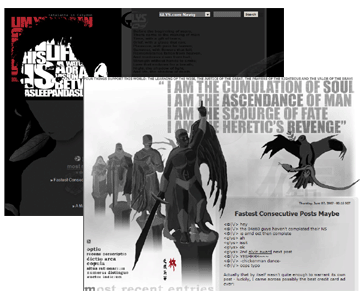
Atalanta vs Cumulation Fresh, light look, huh? Don't worry, the old skin (now codenamed Atalanta) remains available, with the skins being as backward-compatible as Windows products *ahem*. No, really, about everything works in both skins, though it was somewhat tedious to adapt the first time round. As for how to switch between skins, eet eez velly simple - skin swopping is the first option under display preferences, which is accessed by clicking the word "optio" on the extreme left of the page (those pseudolatin words cycle through stuff like the colored boxes did in Atalanta). Select the skin you want, click Save to Cookie and you're done. 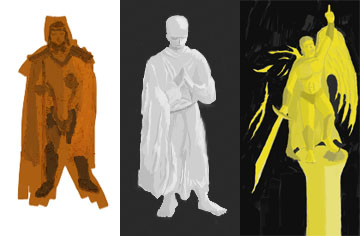
Garish, garish Cumulation didn't come out exactly as I initially envisaged it to. Erm, actually it only barely resembles what I had in mind. The statues were supposed to be in stone, bronze, silver and gold (as can be observed above), there was supposed to be a mass of people at their bases, there was supposed to be an urban landscape in the background, etc etc. I got all the way to the colours of the statues before I knew it didn't work. It looked 'orrible. Likely a more skilled artist would have been able to wring it out, but I was nowhere near that technically adept, and I was looking at a loss of ten-plus hours of brushwork, with no hope of salvaging my initial vision in the short-term. It took a night of thinking in bed (a habit which I have got to kick someday so that I can actually fall asleep in less than an hour) before a solution, which you now see, struck me. Back to basics. Minimalist shades of grey. Simple is good (in websites at least). Thus, back to Photoshop, convert to grayscale, tweak brightness and contrast, presto! Something presentable, and at the very least shouldn't trigger any epileptic fits like the ill-advised London 2012 Olympics logo. And it cost some US$800 000, so I'm ahead on the budget too. Then again, I believe that taste can be cultivated. Just look at my site logo when I was in Secondary school (can tell I liked green even then): 
My eyes, my eyes! Oh my *beep*.
<@|\/> hey <@|\/> the 04s60 guys haven't completed their NS <@|\/> is arnd oct then complete <g!ys> ah <g!ys> issit <g!ys> ok <g!ys> 2nd alvin award next post <@|\/> YESHHHH~~~ <@|\/> -chickenman dance- <@|\/> oops typo Actually that by itself wasn't quite enough to warrant its own post - luckily, I came across possibly the best credit card ad evar:
- outings - It's been a pretty busy weekend as far as I'm concerned. Here goes: Saturday Participated in Paint A Home 2007 at the Bishan Home for the Intellectually Disabled, thanks to some prodding during the data entry project. Turned out that a sec sch pal had crashed the event without warning, though we ended up in different groups. Didn't see too much of the residents after arrival, but they seemed friendly and harmless enough. Lesson #1: The differently-abled sure like to shake hands - human contact, I guess. Sat through a short briefing, then my group started whitewashing the walls at about 11 a.m., breaking for a savory catered lunch on a plastic tray, no less, at one-something. Lesson #2: Try not to paint walls with a brush - a dedicated roller is far better. One of the other volunteers remarked that the person who invented the roller was pretty smart, and indeed the invention appears fairly recent despite the wheel it was likely inspired from being around for thousands of years; Credit goes to one Norman Breakey, who thought the tool up in 1940. Whitewashing an average-sized room didn't take long with roughly ten pairs of hands, and after that some of us stayed behind to chalk out the mural outlines on the walls while others went to interact with the residents. Well, being sort of an old hand at reproducing images, I completed the F(rog), G(oat) and J(am) portions, and even managed some plaudits for rendering a "cute frog". Haha. Got a random bookmark done by one of the residents as a keepsake at the end, which turned out to be reasonably appropriate - the kind soul who did it almost got my name right :P 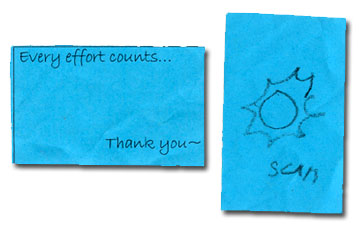
Sun/San If you feel very gian now, have no fear - Project C.A.N is still open for registration (I think). Sunday JC class outing at Sentosa. Turnout at 11 a.m. wasn't that great however. My first ride on the new tram, which cuts straight across to the beaches - the island sure seemed larger with the old monorail. Alvin brought his new volleyball, which was impressively soft (insert inappropriate joke here). Peter brought a netball that really looked like a volleyball, and had all of us fooled for a long time. It was also much, much harder. Lesson #3: If you value your radius bone, do not attempt to play volleyball with a netball. The beaches were crowded with SMRT employees due to SMRT Day, but we got an invitation from a bunch of self-professed 40-somethings who had their own US$500 net and stands - they looked suspiciously in their thirties. They weren't half bad either (but hey, they were serious enough to have their own equipment), and ended up winning all but one of our games. Lesson #4: Extremely hot sand can be countered either by continually sweeping the surface sand apart with feet, or just wearing shoes. Lesson #5: Ask for help in applying suntan lotion to your back, if you don't want interesting patterns on it the next day. Broke for lunch, then joined up with the juniors and grand-grand juniors (the guys among them have already completed their NS! Darn, I'm old). A bit of soccer, some frisbee. Lesson #6: Don't drink carbonated drinks on an empty stomach. Ended up with dinner and some chit-chatting at VivoCity. Monday Sec sch class outing at Marina Square, 7 p.m. Perhaps not so much outing as freeloading, but hey, that's us :) Well, the story behind it was that csq bet smk four Earthquakes that he would get his first non-A grade this semester, which just goes to show that intelligence is no guarantee of savvy investing; As any sane person might have expected, csq lost the bet, and what use would a single person have for 32 scoops of sinful delight? Hence, the call to arms. And mouths. So, technically speaking it was smk's treat, but it wouldn't be nice not to give credit to the poor guy who footed the bill for four Giant Earthquakes, right? 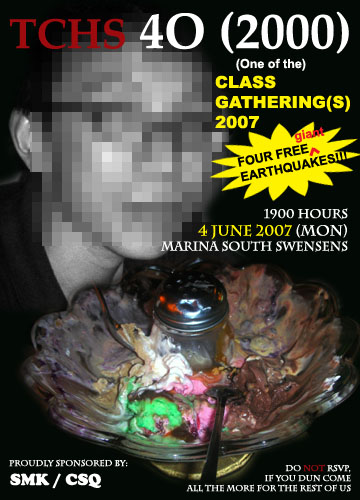
A Word From Our "Sponsor" - Photo credits: Law Lesson #7: Baked rice is deceptively hot. Lesson #8: Do not order "Yummy Raisin" flavoured ice-cream. Nice to see some of them, after such a long time. Four of us headed to the bowling alley after the obligatory class photo, where I discovered just how out of touch I was - average score hovering around 100. Interestingly, it appears that my "natural" shot (straight from edge of gutter) is supposedly the ideal method to strike, if I could just get it to the 1-2 pocket consistently. A very big if.
|
|
||||||||||||||||||||||||||||||||||||||||||||||||||
 Copyright © 2006-2026 GLYS. All Rights Reserved. |
|||||||||||||||||||||||||||||||||||||||||||||||||||