|
| |
|
| |

|
|
|
|
TCHS 4O 2000 [4o's nonsense] alvinny [2] - csq - edchong jenming - joseph - law meepok - mingqi - pea pengkian [2] - qwergopot - woof xinghao - zhengyu HCJC 01S60 [understated sixzero] andy - edwin - jack jiaqi - peter - rex serena SAF 21SA khenghui - jiaming - jinrui [2] ritchie - vicknesh - zhenhao Others Lwei [2] - shaowei - website links - Alien Loves Predator BloggerSG Cute Overload! Cyanide and Happiness Daily Bunny Hamleto Hattrick Magic: The Gathering The Onion The Order of the Stick Perry Bible Fellowship PvP Online Soccernet Sluggy Freelance The Students' Sketchpad Talk Rock Talking Cock.com Tom the Dancing Bug Wikipedia Wulffmorgenthaler       |
|
bert's blog v1.21 Powered by glolg Programmed with Perl 5.6.1 on Apache/1.3.27 (Red Hat Linux) best viewed at 1024 x 768 resolution on Internet Explorer 6.0+ or Mozilla Firefox 1.5+ entry views: 84 today's page views: 849 (85 mobile) all-time page views: 3875470 most viewed entry: 18739 views most commented entry: 14 comments number of entries: 1290 page created Sat Sep 19, 2026 14:49:23 |
|
- tagcloud - academics [70] art [8] changelog [49] current events [36] cute stuff [12] gaming [11] music [8] outings [16] philosophy [10] poetry [4] programming [15] rants [5] reviews [8] sport [37] travel [19] work [3] miscellaneous [75] |
|
- category tags - academics art changelog current events cute stuff gaming miscellaneous music outings philosophy poetry programming rants reviews sport travel work tags in total: 386 |

| ||
|
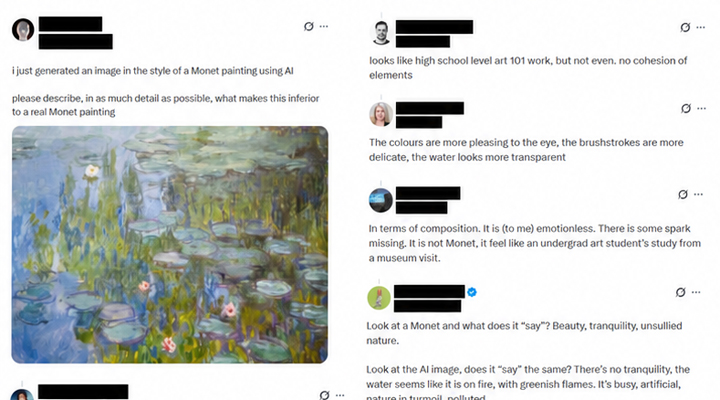 What would the real Monet have thought of this? [N.B. That said, he did supposedly paint some "slop" for money too.] (Source: i.redd.it) Several months ago, a delightful troll posted an image claimed to be AI-generated in the style of epochal French Impressionist Claude Monet on X, and requested other users to roast it. The offer was duly taken up by hundreds of eager commentators, who pointed out a general lack of coherence and an absence of emotion and tranquility, with one critic pronouncing that it "looks exactly like somebody trying to replicate the style and achieving like 20% of it" - with these being the kinder posts. The twist is that the image was of a real Monet from 1915, and possibly worth upwards of US$60 million, for those interested in that sort of thing. This prank is of course just the latest in a long string of episodes demonstrating discrimination against AI agents, though generative AI art has definitely come a long way since our brief coverage of DeepDaze in 2021, which was contrasted against Midjourney in early 2022. The scene has come a very long way since these early examples, though it should be noted that (an admittedly human-refined) AI artwork by Midjourney had already won a Colorado fine arts competition back then. One daresays high-quality image generation to have become fully commoditized since (with support from the increasing volume of GPT Image 2 illustrations featured on this blog) 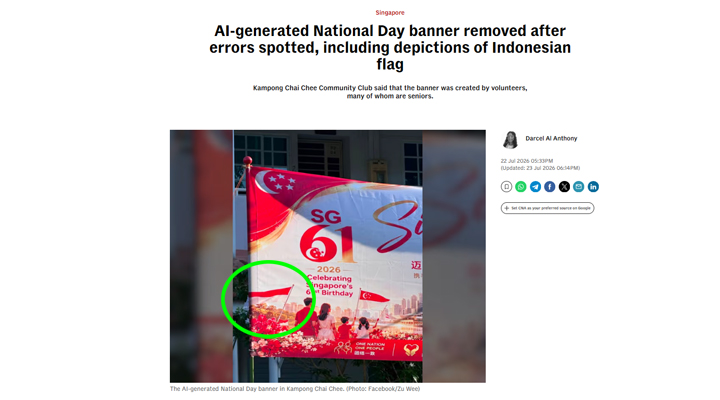 But all ASEAN what, kawan kawan? (Original source: channelnewsasia.com) As another example of the penetration of AI imagery to the general populace, there has been a proliferation of AI-generated graphics in the run-up to our upcoming National Day, the most prominent gaffe of which was perhaps the AI model failing to render the crescent moon and stars on the reverse of the Singapore national flag on one banner, and thus transforming it into the Indonesian bicolour (with the crescent moon apparently representing Islam, and the stars inspired by the People's Republic of China). As kind of expected, the relevant Community Club HR attributed the mistake to their senior citizen volunteers rather than issue a simple apology for the oversight, which brought netizen queries as to whether the head honchos would claim the credit were the banner to be praised for its aesthetics. A second mistake would have the crescent moon and stars present on the reverse, but now facing the same (wrong) way, though this appears to be a botched Photoshop job after the first error broke. That said, this may reflect a certain not-irrational basis of reasoning behind the AI model used for the above - how would an AI know what is supposed to be on the other side of an object, in this case a flag? One could not help but pose the question to the latest and greatest GPT Image 2, which successfully generated the correct reverse image despite my sloppy grammar - so maybe the lesson here is to use the newest AI models where available... 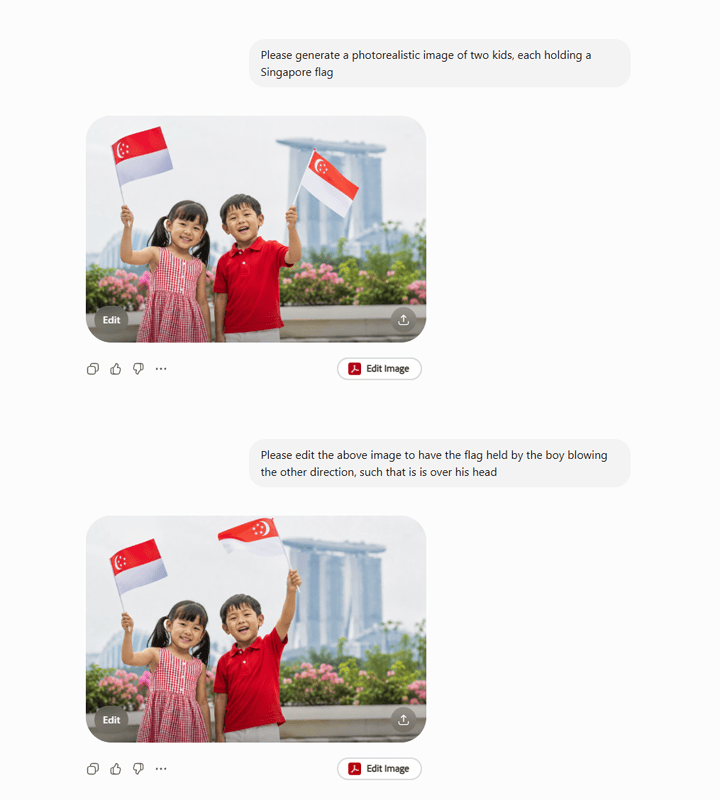 Please pay for GPT subscription hor [Embiggen!] [N.B. Not all flags welcome for display here, note.] (Source: GPT Image 2) Switching from image-based art to music, there has been a parallel trend with AI-generated songs being soundly thrashed on Reddit, if with a few more-honest and self-aware contributors willing to admit that they can no longer be certain of discerning such AI tunes from human ones. This too goes a long way back, at least to the late professor of music David Cope's EMI program from 2001, which was later developed (and anthropomorphized) into Emily Howell, a self-learning computer program that was able to incorporate textual feedback into refining its work. One of Emily's compositions would be praised by a visiting professor as "one of the most beautiful pieces he had heard in a long time" back around 2009, only for the same worthy to deride it as having "no guts, no emotion, no soul" once he learnt that it was by an AI - which he had known all along, obviously! AI in music has improved greatly since then too, with entire artistes - inclusive of lyrics, tunes, album art and even the persona - capable of being generated. Synthetic anime-style idols have been around for awhile, from Gorillaz on MTV to Hatsune Miku and now KPop Demon Hunters, though these did have actual human singers providing the vocals. This may not be the case for the latest crop of (AI?) stars, however, with serious doubts as to whether Spotify Top 50 jazz singer Sienna Rose is an AI bot or not - not least due to her prodigious output of eight albums in a year. The human competition isn't exactly making it very hard either, given how popular song lyrics have apparently been getting simpler and more repetitive, if with some concerns over the sampling methodology of the study. Guy clearly spent decades in the prairie to cultivate this country soul [N.B. Nah just kidding, it's 100% AI.] Sure the lyrics might not exactly be earth-shattering, but the uncomfortable realisation is increasingly that AI-generated music is now more than "good enough", in the sense of being at least as good as the median (human) offering on streaming platforms. The European Union's implementation of AI transparency laws requiring chatbots to identify themselves - coming alongside China's latest ban on them posing as romantic partners and relatives - should then be recognized as the final word on whether the Turing test has been passed; it has, and not only that, it is simply the new normal. [To be continued...] Next: Eye For An AI (Liberal Arts)
|
|
||||||
 Copyright © 2006-2026 GLYS. All Rights Reserved. |
|||||||