|
| |
|
| |

|
|
|
|
TCHS 4O 2000 [4o's nonsense] alvinny [2] - csq - edchong jenming - joseph - law meepok - mingqi - pea pengkian [2] - qwergopot - woof xinghao - zhengyu HCJC 01S60 [understated sixzero] andy - edwin - jack jiaqi - peter - rex serena SAF 21SA khenghui - jiaming - jinrui [2] ritchie - vicknesh - zhenhao Others Lwei [2] - shaowei - website links - Alien Loves Predator BloggerSG Cute Overload! Cyanide and Happiness Daily Bunny Hamleto Hattrick Magic: The Gathering The Onion The Order of the Stick Perry Bible Fellowship PvP Online Soccernet Sluggy Freelance The Students' Sketchpad Talk Rock Talking Cock.com Tom the Dancing Bug Wikipedia Wulffmorgenthaler       |
|
bert's blog v1.21 Powered by glolg Programmed with Perl 5.6.1 on Apache/1.3.27 (Red Hat Linux) best viewed at 1024 x 768 resolution on Internet Explorer 6.0+ or Mozilla Firefox 1.5+ entry views: 101 today's page views: 282 (14 mobile) all-time page views: 3906003 most viewed entry: 18739 views most commented entry: 14 comments number of entries: 1295 page created Thu Oct 22, 2026 08:20:40 |
|
- tagcloud - academics [70] art [8] changelog [49] current events [36] cute stuff [12] gaming [11] music [8] outings [16] philosophy [10] poetry [4] programming [15] rants [5] reviews [8] sport [37] travel [19] work [3] miscellaneous [75] |
|
- category tags - academics art changelog current events cute stuff gaming miscellaneous music outings philosophy poetry programming rants reviews sport travel work tags in total: 386 |

| ||
|
 Regardless of race, language, religion or subspecies... [N.B. From the recent AFA Anime Garden 2026 event at Gardens by the Bay, where they did my oshi Vodka dirty in the voting. Anyway, from left to right and another view, we have an Oguri Cap, a Tazuna, maybe a Stay Gold, possibly two Satono Diamonds, a Still In Love, a T.M. Opera O and a Calstone Light O (the last two not facing the camera)] (Source: r/singapore) Shifting to the "soft power" that Asian giants such as Japan, South Korea and now China are increasingly leaning on (if used to promote the Iran War too), it's time for a cultural/gaming review, this being the Chinese Year of the But first, what's an Uma (Musume)? Well, it's literally "horsegirl" (ウマ娘) translated from Japanese, and not too far from the Chinese ma (马). As the frame story goes, "They are born to run. They inherit the names (and souls) of horses (who were isekai-ed) from another world, whose histories were sometimes tragic and sometimes wonderful, and run ever forward...". Now, this trope is hardly new; I vaguely remember a horse girl (i.e. girls [very] interested in horses) clique from primary school, and the (male) brony subculture got rather big in the 2010s before seemingly petering out. While "anime horse girls" might appear a little niche as a theme - in a Western context, anyway - Cygames has IMHO quite successfully broadened its appeal to the general population by marketing it from various angles. As a sports (racing) anime/manga, Uma Musume: Cinderella Gray is up there with the likes of Slam Dunk in storytelling and art quality, and U:PD is frankly a very well-designed sports management/roguelike hybrid game; being a longtime Hattrick/Championship Manager and ADOM/Slay the Spire player myself, I suppose it was inevitable that I try this out for myself. Additionally, the game has a visual novel wrapper over it for more-casual fans, which makes it quite approachable as a narrative medium. 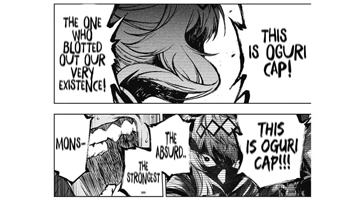 Yeah, it's peak. (Source: mangadex.org) Cygames took the "reincarnated horses" assertion very seriously, by the way. The major story arcs of the Umas are nearly always accurate when referencing real-world events (i.e. who won or finished in which position in what race), so there would be very little suspense for Japanese horse racing buffs reading the manga. Cinderella Gray for example faithfully follows Oguri Cap's career, progressing from hungry countryside no-pedigree bumpkin to unlikely superstar, whose only failures were in the Japan Cup and Tenno Sho, before retiring as a legend by winning the Arima Kinen (Japan's All-Star finale) For those who prefer anime, the first season is out on Netflix, with there being three previous seasons centered around other eras. But back to the mobile game, it should first be noted that it's a gacha game, where players have to use the in-game Carat currency to recruit new Uma characters and Support Cards. This generally involves "pulling" or "rolling" ten Umas or cards at a time, for a price of 1500 Carats. Acquiring an Uma unlocks her for the career scenarios (three currently available for the Global version), which allow six Support Cards to be applied to provide stat boosts and useful events during the scenario. The player takes on the role of the Uma's trainer within each career scenario, and decides (well, mostly) the Uma's training and race schedule over 72 turns. Simply put, each Uma has five stats (Speed, Stamina, Power, Guts, Wits; very similar to D&D-type games), and can learn various skills some of which are suited to particular running styles, or track lengths/conditions. In general, having higher stats and more skills is desirable, since they translate to better performance during races. While the importance of races varies between scenarios, all of them require some wins (or placements) to achieve a good ending for the Uma's career (i.e. win the scenario). Once the career scenario is completed, the Uma becomes a veteran, and can be used to compete against other players (the PvP aspect) 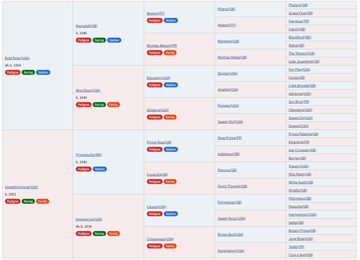 The Great Secretariat's pedigree [N.B. How many people know all their great-great-great-grandparents?] (Source: jbis.jp) In addition, veteran Uma can be used as legacies for new Umas at the beginning of their career, which is the game's implementation of racehorse pedigrees. This inheritance of beneficial traits is represented by three "inspiration" events, one at the beginning of the first (Junior) year, and two right before early April in the second and third (Classic and Senior) years. Of course, this standard three-year career is also based on that of a typical racehorse, who usually runs some ungraded or lower-grade races when two years old, before major graded races in their third and fourth years (including national Triple Crown races that are restricted to three year-olds), and then often declining (as happened to Oguri Cap) and retiring afterwards. In U:PD, the potential of an Uma as a legacy is independent of her reputation and racing record, again reflecting real life where some champions were entirely poor at being sires (and vice-versa). Once an Uma's career is completed, her Inspiration Sparks will be determined according to her stats, affinities and acquired skills, in a highly random process. For example, her blue (stat) spark is first randomly selected from the five stats, with there then being only a 10% chance of getting a maximum three-star spark even if her value for that stat is 1100 or greater (out of 1200 maximum, for now). As can be imagined, acquiring excellent legacy Uma can be a huge grind that requires repeatedly running careers, similar to ascensions in roguelike games. Oh, and there's no redos when training decisions turn out badly - all turns are done on the server. All this creates a gameplay loop at multiple levels. For those that just want to read a Uma's story, all that is needed is to get through her career, which should frankly not be a challenge after awhile. For the more-competitive who want to contend against other players (in the weekly fifteen-Uma Team Trials, or monthly three-Uma Champions Meetings), however, this would require training the best Umas possible. And since this requires acquiring the best sparks on their legacies and grand-legacies, serious trainers begin not by grinding on their desired ace Uma nepobaby, but on that Uma's planned grandparents!  Singapore represent! [N.B. Full screen, the Winning Well, not that I had time for all that, having just started U:PD in late February, but as it turns out research & analysis skills (and all that experience in virtual football management and roguelikes) has its uses; admittedly the true top players are all in Class 6 (most of whom likely had started since U:PD's global English release last June), but finishing first out of probably several hundred thousand players in Class 4 (since one can only promote a single class each week, with promotion lines estimated at the top third of a class) still feels kinda good. In this case, the high score came from a five-win sweep with all five Aces winning their respective races for much bonus points, which doesn't come along all that often... [To be continued...] Next: More On The Uma
|
|
||||||
 Copyright © 2006-2026 GLYS. All Rights Reserved. |
|||||||