|
| |
|
| |

|
|
|
|
TCHS 4O 2000 [4o's nonsense] alvinny [2] - csq - edchong jenming - joseph - law meepok - mingqi - pea pengkian [2] - qwergopot - woof xinghao - zhengyu HCJC 01S60 [understated sixzero] andy - edwin - jack jiaqi - peter - rex serena SAF 21SA khenghui - jiaming - jinrui [2] ritchie - vicknesh - zhenhao Others Lwei [2] - shaowei - website links - Alien Loves Predator BloggerSG Cute Overload! Cyanide and Happiness Daily Bunny Hamleto Hattrick Magic: The Gathering The Onion The Order of the Stick Perry Bible Fellowship PvP Online Soccernet Sluggy Freelance The Students' Sketchpad Talk Rock Talking Cock.com Tom the Dancing Bug Wikipedia Wulffmorgenthaler       |
|
bert's blog v1.21 Powered by glolg Programmed with Perl 5.6.1 on Apache/1.3.27 (Red Hat Linux) best viewed at 1024 x 768 resolution on Internet Explorer 6.0+ or Mozilla Firefox 1.5+ entry views: 629 today's page views: 756 (26 mobile) all-time page views: 3904361 most viewed entry: 18739 views most commented entry: 14 comments number of entries: 1295 page created Wed Oct 21, 2026 05:36:14 |
|
- tagcloud - academics [70] art [8] changelog [49] current events [36] cute stuff [12] gaming [11] music [8] outings [16] philosophy [10] poetry [4] programming [15] rants [5] reviews [8] sport [37] travel [19] work [3] miscellaneous [75] |
|
- category tags - academics art changelog current events cute stuff gaming miscellaneous music outings philosophy poetry programming rants reviews sport travel work tags in total: 386 |

| ||
|
Before beginning, a quick more-meta statement of clarification: this is an individual (if not particularly private) blog. In it, I express my (generally genuinely-held, if at times perhaps mildly trollish) opinions. In the greater picture, this blog has a fairly limited reach - one would hardly be able to find it from regular search engines (I know, I've tried), from the lack of SEO. Indeed, the content almost certainly has far less discoverability than were it posted directly to Facebook/Substack/Twitter etc., which however suits me just fine, given how such platforms are known to push posts for clicks and discord, and how one's writings would then be appropriated by the relevant corporation. And, from how the Ministry of Truth is pushing for Titter to allow their users' tweets to be overwritten by enforcers, one may soon find misattributions on such to be the norm. The trouble with putting stuff down in writing, of course, is that it presents a record of one's views and inclinations, at least at a certain point in time. Far more convenient - particularly in the current era - one supposes, is to make no expression, and thus be able to present as a blank slate socially. Then, one would be able to show one face, or mask, in some company, and another face/mask in another company, and so on. Oh, nothing wrong with this, certainly; it is just that I account it basic respect not to misrepresent myself thus, if not absolutely necessary. All I can offer, where unhappy disagreements are likely, is a non-committal (non-dualistic?) silence, and in certain cases, a withdrawal. This is the fairest outcome I can offer. The above stated, we return to the main topic of the day, which is the validity of (future) prediction. Previously covered in 2016's Stat, Stat! and 2014's This Ancient Art, a major takeaway might be that such prediction can hardly be expected to be 100% accurate, especially in the humanities (whereas science is often essentially the discovery of natural laws, that allow exact prediction within some bounds), but it is certainly a skill that one can objectively improve at, once proper targets are defined. It also happens to be a little hobby of mine, and one at which I humbly claim some decent calls with respect to cryptocurrency price trends, soccer tournaments, political predictions (thought unlikely by "experts") etc., and usually with extensive logical explanation. One finds it hard to apologize for such. 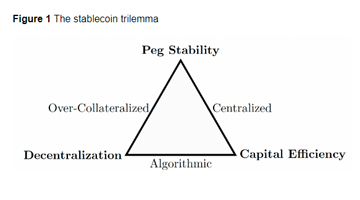 The impossible trinity (Source: voxeu.org) It's tough to resist sneaking in the just-officially reconfirmed Fed chair's quite abrupt (and well-documented) U-turn on inflation here, with the worthy chap suddenly admitting that they were possibly slow on the uptake, 75 basis points is on the table, a soft landing is out of his control and this may hurt you more than it hurts me. However, this might not even be the biggest piece of financial news for the past week; if we're going by social media and forum chatter, that distinction must belong to the depegging of the UST so-called stablecoin, and the ensuing cratering of the related LUNA token on the Terra blockchain. A little background may be in order, seeing as we have been away from the crypto scene for some time. Every mad crypto boom thus far has had its fads (2013: [the first] altcoins, 2017: ICOs, 2021: NFTs, also crashing), and the rise of algorithmic stablecoins might be accounted as one, for this cycle. A "stablecoin" is a crypto token that is intended to hold its value, against some chosen currency (usually the U.S. dollar), as opposed to having its value float freely (e.g. Bitcoin, Ethereum, most other cryptocommodities). As one can imagine, this property of maintaining a stable value is very useful when transacting in the crypto marketplace. Instead of having to continually transfer funds in and out of traditional banks (incurring fees each time), a stablecoin allows market participants to keep their funds liquid and deployable in the crypto space itself... or that is the theory, at least. The big question then becomes: how can a stablecoin's peg to a chosen currency be maintained? This has been studied, and the conclusion is that a stablecoin cannot fulfil all three desirable properties of decentralization, peg stability and capital efficiency simultaneously. A common solution is to give up decentralization, as with the OG Tether (and USDC, GUSD, etc.). In these cases, the issuers of the stablecoin create one token for each (real) fiat dollar they received, and if they simply hold on to those dollars, it is clear they can then allow users to cash out tokens for dollars (and burn/destroy the retired tokens). For such centralized stablecoins, the risk arises from the issuer being unable or unwilling to access the fiat backing for withdrawal, possibly in turn due to counterparties like their correspondent banks, or due to engaging in speculation with their backing funds. Otherwise, the mechanism is very simple. 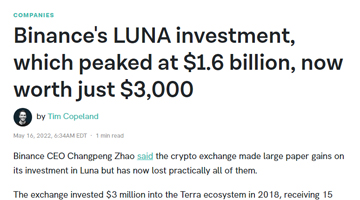 Easy come, easy go (Source: theblockcrypto.com) If we insist on decentralization, then, the level of collateral becomes especially important. Some, like DAI, are backed by (in theory) far more value than the issued stablecoin tokens are worth. Others, as the dearly-departed UST, are not. While there are now many tellings on hindsight of why it failed, the gist of it might be summarized as: the peg on UST was supposed to be maintained automatically via market incentives; since the Terra blockchain enabled users to swap 1 UST for US$1 worth of the LUNA token at all times, the idea was that if UST were worth too much, users would just buy UST with LUNA, and if UST were worth too little (the more pressing case), users would buy LUNA with UST (or equivalently, the issuers could create new LUNA, and sell it for UST). Demand for UST was further driven by the Terra blockchain owners creating an Anchor protocol, that offered 20% annual interest on UST (supposedly equivalent to the U.S. dollar, recall). So far, so good. The problem - as actually anticipated by not a few economists and regular commentators - was that there is actually no real guarantee that creating new LUNA would be sufficient to support the UST peg, once confidence in the system is shaken (possibly, but not necessarily, due to a deliberate Soros-style attack). When that happens, the issuance of LUNA tokens would naturally encourage the price of the token to fall, which would in turn reduce demand in LUNA, which further crashes the price, in what could - and did - become a total death spiral. In fact, this very analysis has been covered here back in 2018, where the question of whether a non-backed (or in this case, poorly-backed) stablecoin could work was answered in the negative, with reference to Basecoin and the experience of actual central banks; one supposes that cryptocurrency bootcamps might not in general be heavy on a classical education in economics. And, as it happens, the founder of Terra/UST/LUNA was actually behind at least one other failed algorithmic stablecoin - Basis Cash (BAC) - already, which was itself modeled on Basecoin. This brings to mind the quote on insanity being doing the same (provably flawed) thing over and over again and expecting a different result, and while he has expressed heartbreak at the latest evaporation of users' funds, it might have been slightly more convincing were it not for his attitude towards critiques beforehand. Anyway, the freshly Singapore-based founder is having his offices staked out and has had a police report made against him by one of the many disgruntled local victims, which however may be the least of his troubles. There have also been the expected knock-on effects on other stablecoins like Tether, exchanges such as Coinbase and Bitcoin itself, but those appear to have been defended/have passed... for now. By the way, seeing as my best understanding is that the latest crypto bull run was mostly due to Fed money creation (as with the rest of the stock market, especially tech), let's just say that I was not kidding about the US$6k target price to get back in, from December 2020. Next: Game Status Update
|
|
||||||
 Copyright © 2006-2026 GLYS. All Rights Reserved. |
|||||||